


Good morning, and welcome to The Ship Show!
Fall is almost here, bringing with it football, flannel, decorative gourds, and approximately 11 days of perfect weather before the forecast turns into a damp gray hostage situation.
Of course, we’re not actually in fall yet, and that’s for two very important reasons:
Still, that won’t stop any of us from trying to manifest fall into existence the second September arrives.
So while we wait for the weather to finally cooperate, here are a few perfectly reasonable ways to pretend fall is already here:
That’s really the beauty of early fall. It doesn’t actually have to be fall. We just have to agree that it is.
And remember, fall isn’t just about the pumpkins, the football, the flannels, or the two perfect Saturdays we’ll collectively talk about until next April.
It’s about clinging desperately to the last scraps of seasonal serotonin before the clocks change, the trees go bald, and the black hole of winter depression opens up and engulfs us all.
– Greyson Harris
In this week’s issue:


U.S. manufacturing expanded for an eighth straight month in August, keeping freight demand on solid footing even as growth cooled from July.
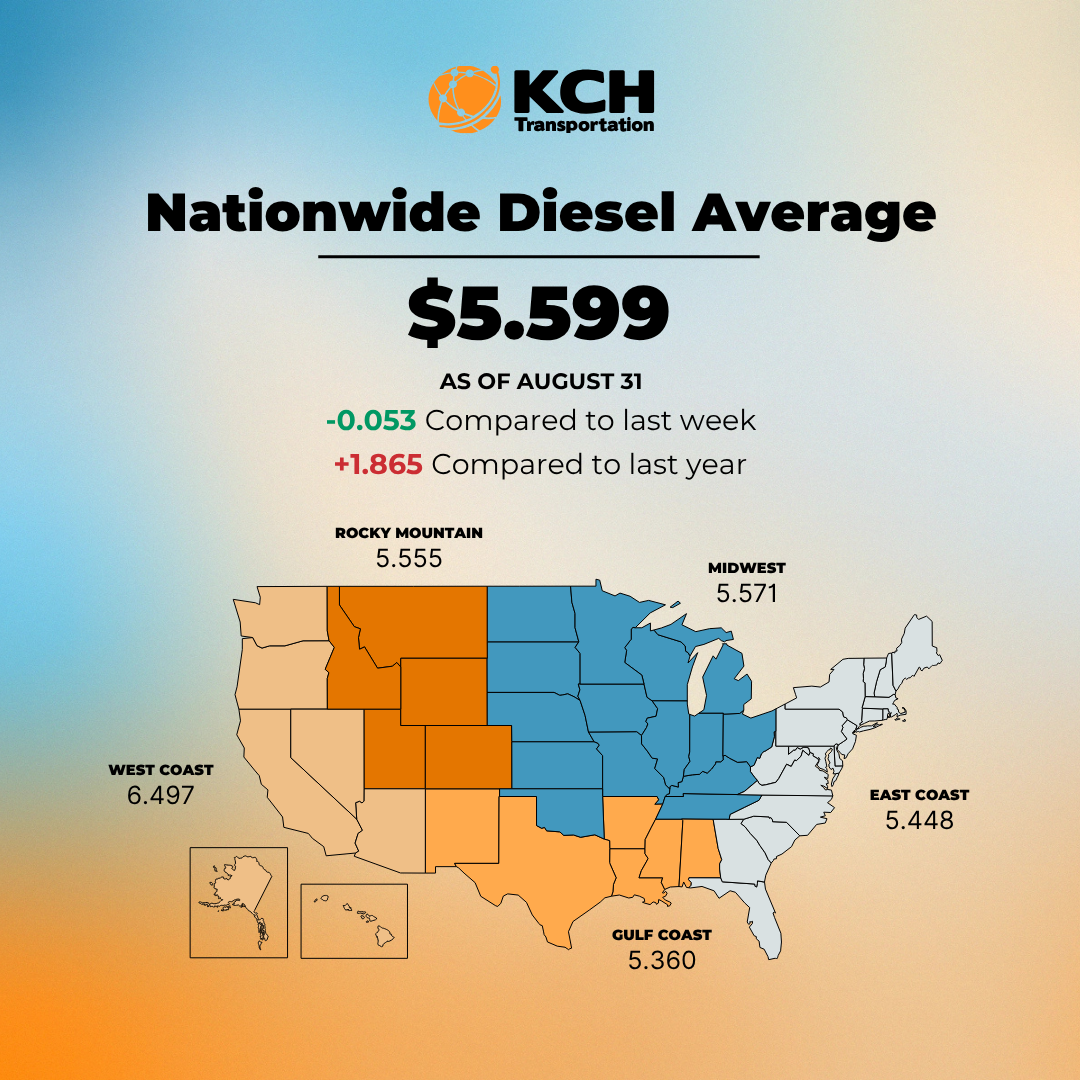
Meanwhile, transportation capacity continued shrinking, utilization climbed, and transportation prices shot even higher.
So the economy is still making stuff, and companies are still moving stuff, but logistics managers are still opening invoices with the emotional preparation normally reserved for medical bills.
The Institute for Supply Management’s Manufacturing PMI registered 54.6 in August, down 1 point from July but still comfortably above the 50 mark that signals expansion.
July had produced the strongest reading since May 2022, so some moderation was probably inevitable.
New orders also remained in expansion territory for an eighth consecutive month, although the index slipped 3 points to 53.7. Backlogs stayed positive at 51.8, while production remained strong at 58.3.
Some of that slowdown could be tied to companies pulling inventories forward earlier this summer ahead of tariff implementations, essentially doing some of August’s homework in June and July.
Employment also remained positive at 51.2 after finally returning to growth in July for the first time in 33 months. Overall, the August PMI was consistent with annualized real GDP growth of roughly 2.4%.
Not exactly booming, but the factory lights are still on.
Transportation capacity remained firmly in contraction during August, according to the Logistics Managers’ Index.
The capacity index came in at 40. For context, anything below 50 signals contraction, meaning available transportation capacity continued disappearing from the market.
There was one bit of good news: it disappeared more slowly.
August’s contraction rate was 11.6 points slower than July, when capacity declined at the second-fastest pace in the LMI’s 10-year history.
Transportation utilization, meanwhile, jumped 5.6 points to 70.6, marking only the second time in five years that the measure reached “robust” growth territory.
So, congratulations to transportation capacity for falling off the cliff at a slightly more responsible speed.
The price tag is now officially extreme.
Transportation pricing climbed to 90 in August, up another 3.1 points and reaching “extreme” growth territory for the fourth time in five months.
Logistics managers do not expect much relief anytime soon. Looking out over the next 12 months, respondents projected transportation capacity at 43, utilization at 71.9, and pricing at 86.1.
Manufacturers and wholesalers were especially pessimistic about capacity, returning a future reading of 38.6, while retailers were more optimistic at 54.5.
The LMI summed things up nicely, noting that logistics costs seem to be “rapidly increasing no matter what the underlying situation is.”
The inventory shuffle continues.
The overall Logistics Managers’ Index came in at 66.6, down 2.2 points from July as inventory growth slowed.
Inventory levels registered 52.8, remaining in expansion but growing at a more modest pace.
Retailers reported stronger inventory growth at 61.9, while manufacturers and wholesalers slipped slightly into contraction at 49.
That reversal from July suggests retailers may be rebuilding inventories for the fourth quarter after drawing them down during the back-to-school season.
But holding all that inventory remains expensive. Inventory costs climbed to 78.6, warehouse prices stayed elevated at 75, and aggregate logistics costs reached 243.6.
For reference, 150 represents the breakeven level.
Slower supply.
Manufacturers also reported slower supplier deliveries for the ninth straight month. ISM’s supplier deliveries index rose slightly to 59.3, signaling longer delivery times and continued supply chain constraints.
None of the 14 manufacturing industries tracked by ISM reported faster supplier deliveries in August compared with July.
Raw material costs remained another major concern. The ISM prices index held at 71.1, marking the 23rd consecutive month of rising input prices.
Pricing volatility was the most common concern among negative survey responses, and overall manufacturer sentiment remained fairly gloomy, with 42% of comments positive and 58% negative.
And that sentiment pretty much sums up the current freight market. Factories are expanding. Orders are growing. Trucks are busy. Capacity is tight.
On paper, there is plenty to like. Until you look at the price tag.

Federal transportation officials are moving to shut down hundreds of commercial driver training operations as part of a sweeping crackdown on fraudulent licensing, weak testing standards, and unsafe practices across the trucking industry.
Transportation Secretary Sean Duffy announced Monday that more than 110 CDL schools are being removed from the federal registry, with another 160-plus facing potential removal.
The effort also includes a nationwide audit of third-party skills testers, a Homeland Security Investigations operation spanning 23 states, and a new Justice Department task force focused on trucking-related fraud and criminal activity across major Midwest freight corridors.
DOT has not released the full list of affected schools, but officials highlighted several examples during Monday’s announcement.
Among them:
Duffy said the 110 schools already removed from the registry accounted for roughly 5,000 English-language proficiency violations.
The enforcement effort is also focused on third-party CDL examiners. Duffy said federal investigators identified 10 skills testers in one state who collectively issued more than 2,000 CDLs to drivers who were later unable to satisfy English-language proficiency requirements.
DOT said more than 28,000 commercial drivers have been placed out of service for English-language proficiency violations since June 2025. Federal officials say those numbers raise serious questions about how drivers were passing licensing exams in the first place.
FMCSA will now conduct a nationwide review of third-party testing operations and state oversight programs.
Criminal intent.
The federal investigation goes well beyond questionable training practices.
Homeland Security Investigations said it has received more than 1,000 leads involving CDL-related businesses suspected of unsafe practices or exploitation within the transportation industry.
Investigators are examining possible CDL fraud, identity-document fraud, unauthorized employment, money laundering, labor exploitation, shell companies, and potential connections to human smuggling, drug trafficking, and cartel activity.
HSI also planned a coordinated enforcement sweep involving more than 200 driving schools across 23 states. Federal officials have already issued more than 80 notices of inspection and opened multiple investigations.
Midwest coalition.
The Justice Department also announced the Joint Task Force Crossroads of America, which will combine all nine U.S. attorney offices across Michigan, Ohio, Indiana, and Illinois.
The group will work with DOT, FMCSA, FBI, DEA, HSI, ICE, ATF, and state and local law enforcement to investigate trucking fraud and other criminal activity along key freight corridors.
Those four states sit at the center of some of the country’s busiest trucking networks, making them a logical focus for enforcement involving fraudulent licenses, illegal employment practices, and transportation-related crime.
Many drivers welcome tighter enforcement.
The Owner-Operator Independent Drivers Association backed the crackdown, arguing that fraudulent CDL schools undermine both highway safety and drivers who completed legitimate training.
“Nobody cares more about highway safety than professional truck drivers,” OOIDA President Todd Spencer said.
Spencer also renewed calls for Congress to pass Dalilah’s Law, which the group says would strengthen English-language proficiency enforcement and help prevent fraudulent CDL schools from simply reopening elsewhere.
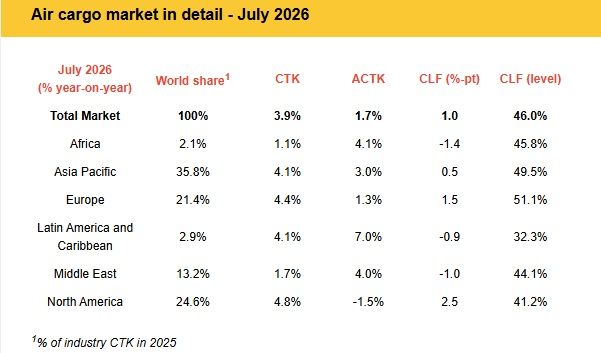
✈️ Air cargo growth cools but stays positive: Global air cargo demand increased 3.9% year over year in July, slowing from stronger gains earlier in 2026, while capacity rose just 1.7%. North American carriers posted the strongest regional growth at 4.8%, followed by Europe at 4.4% and Asia-Pacific at 4.1%. IATA said manufacturing, export orders, and global trade remain supportive, though rising fuel costs, geopolitical tensions, and tariff uncertainty continue to cloud the outlook.
🚂 Rail traffic keeps rolling higher: U.S. railroads moved 532,462 carloads and intermodal units for the week ending Aug. 22, up 4.2% year over year. Carloads increased 3.2%, led by gains in metallic ores and metals, chemicals, and grain, while motor vehicles and parts fell 10.4%. Intermodal volume rose 5%, continuing to outpace carload growth. Through the first 33 weeks of 2026, total U.S. rail traffic is up 3.3% from last year, while combined North American volume is running 3% higher.
🚢 China reshuffles the global port rankings: Ningbo-Zhoushan overtook Singapore for second place in the first half of 2026, while Shanghai held the top spot with 28.7 million TEUs. China claimed six of the world’s top 10 ports. The biggest collapse came at Dubai’s Jebel Ali, which fell from 10th to 32nd as Strait of Hormuz disruptions tied to the Iran war slashed throughput and forced carriers to reroute cargo. Southeast Asian hubs benefited from the reshuffling, with Port Klang entering the top 10. The combined Los Angeles-Long Beach gateway ranked ninth and remained the only non-Asian port in the global top 10.

Nearly 30 years after Tupac Shakur was fatally shot on the Las Vegas Strip, a jury has finally convicted someone in connection with his killing.
Duane “Keffe D” Davis was found guilty Monday of murder with a deadly weapon for orchestrating the 1996 shooting of Shakur, bringing a measure of resolution to one of the most infamous unsolved murders in music history.
The 63-year-old could face life in prison when he is sentenced in October. Jurors needed less than three hours to reach a verdict following a weekslong trial featuring 24 prosecution witnesses and three defense witnesses.
That may sound quick for a case nearly three decades old, but prosecutors had one particularly talkative witness on their side: Keffe D.
For years, Davis gave interviews, appeared in documentaries, wrote a memoir, and repeatedly described being inside the white Cadillac from which the shots were fired.
Turns out, publicly explaining your proximity to an unsolved murder for decades is not an especially strong long-term legal strategy.
Ambitionz as an accomplice.
Shakur was riding with Death Row Records co-founder Marion “Suge” Knight in Las Vegas on Sept. 7, 1996, when a white Cadillac pulled alongside their vehicle at a red light. Someone inside the Cadillac opened fire.
Shakur was struck multiple times and died six days later at age 25. Knight was also wounded but survived.
Prosecutors said the shooting was retaliation for an altercation earlier that night at the MGM Grand, where Shakur, Knight, and members of their group had attacked Davis’ nephew, Orlando Anderson.
Chief Deputy District Attorney Binu Palal told jurors that Davis obtained a gun after the fight and “went hunting” for Shakur and Knight.
Prosecutors did not claim Davis personally pulled the trigger. Instead, they argued that he provided the weapon and organized the retaliation as an influential member of the South Side Compton Crips.
Davis is the only surviving member of the four men prosecutors say were inside the Cadillac. For years, none of them were charged.
And then one of them started doing interviews.
All eyez on Keffe D.
Over the years, Davis repeatedly placed himself inside the Cadillac during interviews, documentaries, and other public appearances. He said he had provided the gun to men in the back seat and described the shooting as retaliation for the beating of his nephew.
Then, in 2019, he co-authored a memoir titled “Compton Street Legend,” in which he again discussed the events surrounding Shakur’s murder.
Prosecutors played jurors an interview in which Davis encouraged people to buy the book if they wanted the “real truth.”
This created a somewhat inconvenient situation for the defense, which later had to argue that the “real truth” being marketed by its own client was, in fact, not particularly truthful.
Defense attorney Michael Sanft said Davis’ stories were exaggerated street bravado designed to sell books and generate attention. He argued that prosecutors lacked physical evidence, including phone records, fingerprints, or forensic evidence directly connecting Davis to the crime.
It was essentially the legal equivalent of saying, “Yes, my client repeatedly admitted involvement in the crime, but have you considered that he may have just been lying for clout?”
Snitches get life sentences.
While details of his account shifted over time, prosecutors said one thing remained remarkably consistent: Davis repeatedly said he was in the Cadillac.
In several interviews, he said he gave the gun to someone in the back seat. In others, and in his memoir, he stopped short of naming the shooter.
And then there was the scrapbook. Prosecutor Marc DiGiacomo told jurors that Davis kept a collection of newspaper articles about Shakur and the murder investigation.
“This guy’s scrapbooking his murder, for God’s sake,” DiGiacomo said during rebuttal arguments.
At some point, your defense attorney probably begins wishing you had taken up literally any other hobby.
Only God (and the U.S. legal system) can judge me.
Sanft repeatedly emphasized the lack of traditional physical evidence tying Davis to the murder. He pointed to the absence of phone records, forensic evidence, and other documentation showing Davis had directed the shooting.
“They have nothing in this case that says that man was here in Las Vegas on Sept. 7, 1996,” Sanft told jurors during closing arguments.
There was, of course, one person who had repeatedly said that man was there: Davis.
Prosecutors argued they did not need to prove Davis fired the weapon himself. Under their theory of the case, Davis organized the retaliation, supplied the gun, and participated in the events that led directly to Shakur’s death.
Jurors agreed.
After the verdict was read, Shakur’s sister, Sekyiwa “Set” Shakur, cried and hugged members of the prosecution team. Shakur’s family said it would wait until Davis’ sentencing in October before commenting publicly.
Sometimes the biggest break in a cold case isn’t new technology, a surprise witness, or a forgotten piece of evidence.
Sometimes the suspect just won’t stop talking.
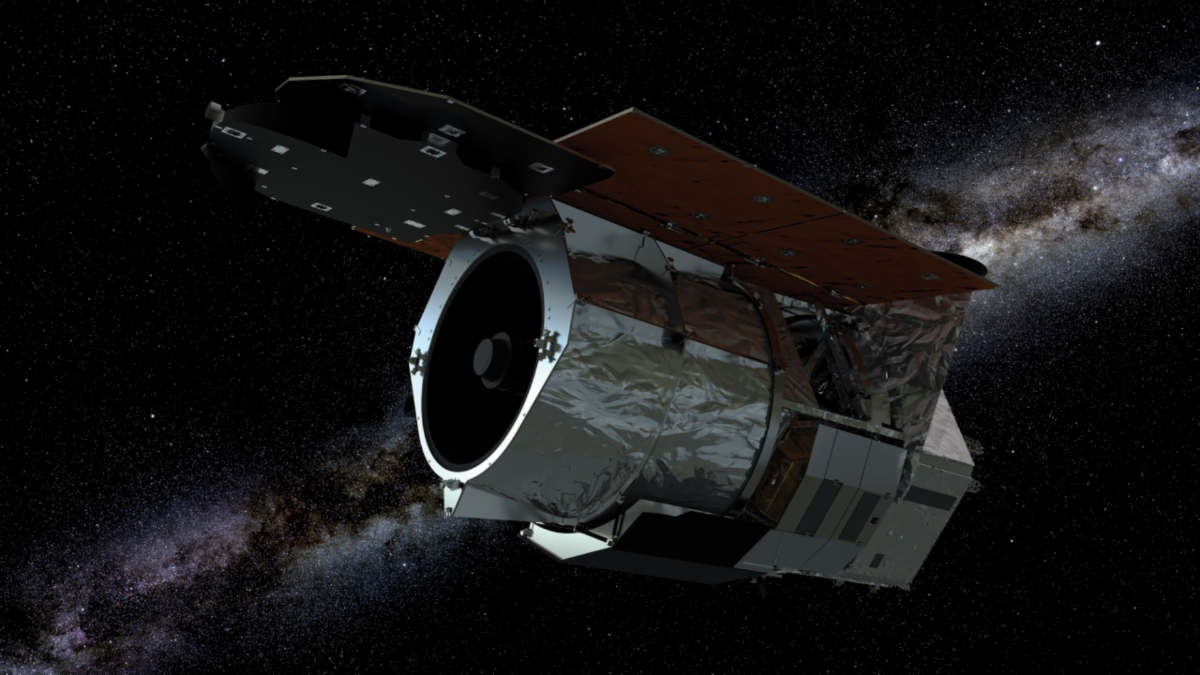
NASA just sent its newest set of eyes into space, and this one came with a very expensive pair of binoculars.
The $4.3 billion Nancy Grace Roman Space Telescope launched Sunday aboard a SpaceX Falcon Heavy rocket, beginning a three-month journey to an observation point roughly 1 million miles from Earth.
Once it arrives, Roman will hunt for planets around distant stars, map billions of galaxies, study dark matter and dark energy, and survey the universe at speeds astronomers have never had before.
NASA officials expect it to find thousands of supernovae, tens of thousands of planets, billions of galaxies, and tens of billions of stars.
Three’s company.
Roman’s biggest advantage is its enormous field of view. The telescope can see an area of the sky more than 100 times wider than NASA’s Hubble Space Telescope while maintaining similar sensitivity.
That means Roman will not necessarily replace Hubble or the James Webb Space Telescope. Instead, the three will work together.
Hubble has spent decades producing highly detailed images of individual targets, while Webb can zoom in even deeper, studying some of the oldest and faintest objects in the universe.
Roman is built to scan enormous stretches of space quickly, identifying interesting targets that its more specialized cousins can investigate later.
“Roman’s vast reach will allow us to find the weird, the rare and the unusual,” senior project scientist Julie McEnery said before launch.
Finally, a telescope with the same search criteria as Facebook Marketplace.
Fast af boi.
Roman’s true superpower is speed. According to NASA, one month of observations by Roman could accomplish a survey of the Milky Way that would take Hubble roughly a century.
Its wide-field infrared camera operates about 1,000 times faster than Hubble, allowing astronomers to rapidly scan the dense center of our galaxy and locate objects that might otherwise take decades to find.
Among them will likely be thousands of previously unknown planets.
Roman also carries an experimental coronagraph, which essentially creates a tiny artificial eclipse by blocking the light from a star. That allows scientists to photograph much fainter planets orbiting nearby.
It is an extraordinarily sophisticated piece of technology developed to answer the timeless question: “What’s that little thing over there?”
Visualizing the invisible.
Roman will also investigate dark matter and dark energy, two things that apparently make up most of the universe despite humanity being unable to see either of them. Comforting.
Scientists believe dark matter helps hold galaxies together, while dark energy appears to be accelerating the expansion of the universe.
Roman will map billions of galaxies and measure how they are distributed across space, giving astronomers more data about how the universe has expanded over billions of years.
It will work alongside the European Space Agency’s Euclid spacecraft and the Vera C. Rubin Observatory in Chile.
Might as well look for aliens while we’re up here.
Roman is not specifically designed to search for extraterrestrial life, but NASA officials say its discovery of new planets could help future telescopes figure out whether another Earth-like world exists somewhere out there.
Once Roman discovers potentially interesting planets, James Webb can take a closer look and study their atmospheres and other characteristics.
“Are we alone?” NASA science mission director Nicky Fox said. “Is there another Earth 2.0 looking back at me?”
Roman may not answer that one, but with billions of galaxies now on the itinerary, it certainly has plenty of places to look.
The Mother of Hubble.
The telescope is named for Nancy Grace Roman, NASA’s first chief astronomer and one of the earliest champions of placing telescopes above Earth’s atmosphere.
Roman joined the newly created NASA in 1959 and spent years advocating for space-based observatories that could see farther and more clearly than telescopes on Earth.
Her efforts helped pave the way for Hubble, earning her the nickname “Mother of Hubble.”
Roman died in 2018 at age 93.
Her namesake telescope is NASA’s first space telescope named after a woman, and retired NASA scientist Ed Weiler said the honor was overdue.
“I think Nancy would be very proud,” he said.



We’re now posting freight on the Trusted Freight Exchange (TFX), a secure, Highway-powered network made for verified carriers like you.
It’s built right into Highway, free to use, and designed to connect you with quality freight fast.
Every KCH load on TFX is:
With TFX, you skip the back-and-forth and get straight to hauling.

The U.S. has 23 million truck parking spots. You should be able to find one without feeling like you’re on a wild goose chase.
We’re teaming up with Truck Parking Club to make that happen.
Use code KCH25 for $25 off your next reservation.
Less wandering. More rest.
Designed for shippers who want straightforward market insight and smarter freight strategies.