State of Freight: May 2026 – Freight Found the Gas Pedal Before Peak Season
The freight market is acting like it chugged three energy drinks, kicked open the door, and announced that seasonality is for cowards.
This is not one quirky corner of the market acting up. It’s several very real demand engines leaning on a supply base that still looks like it skipped leg day for two years.
Let’s break it all down in this month’s freight market update, brought to you by our own in-house squad of transportation nerds.
Flatbed is anything but flat
One of the biggest stories in the flatbed market right now is the physical buildout behind AI.
Not the fantasy version where the cloud does everything by magic. It’s the real version where data centers need structural steel, transformers, switchgear, battery banks, and every other giant piece of industrial hardware that doesn’t teleport itself onto a jobsite. This is where flatbed comes into play.
The numbers back that up in a way that is hard to shrug off:
- Flatbed spot linehaul rates were up 27% year over year in May
- That was a step up from 17% year over year in April
- Flatbed all-in spot rates reached $3.30 per mile, putting them within range of the June 2021 record
That kind of move does not happen because a few people got optimistic on LinkedIn. Private investment in electrical transmission, distribution, and industrial goods has been running well above pre-2020 levels, and hyperscaler spending still has not shown many signs of easing up.
The market is following the buildout lane by lane, and right now the buildout still looks very alive. The cloud, as always, turns out to be made of metal.
Productive Produce
Reefer is the next problem. Or opportunity. Depends which side of the rate sheet you live on.
Mother’s Day flower imports, watermelon season, earlier crop losses, and CVSA Roadcheck all collided with the same reefer pool, which is a nice way of saying capacity got mugged in broad daylight.
Reefer doesn’t really get a slow stretch between here and Thanksgiving, and the pressure is already showing up in the spot market:
- Reefer spot linehaul rates were up 26% year over year
- DAT reefer out of Florida was up 25% year over year
- South Texas to Boston jumped 31% week over week
- Vidalia onion volume rose 27% week over week
CVSA Roadcheck makes the timing even more annoying. It’s not big enough to change the year, but it is absolutely big enough to make one week weird, especially when one in five inspected trucks can wind up parked during the blitz.
Imports are back with vengeance
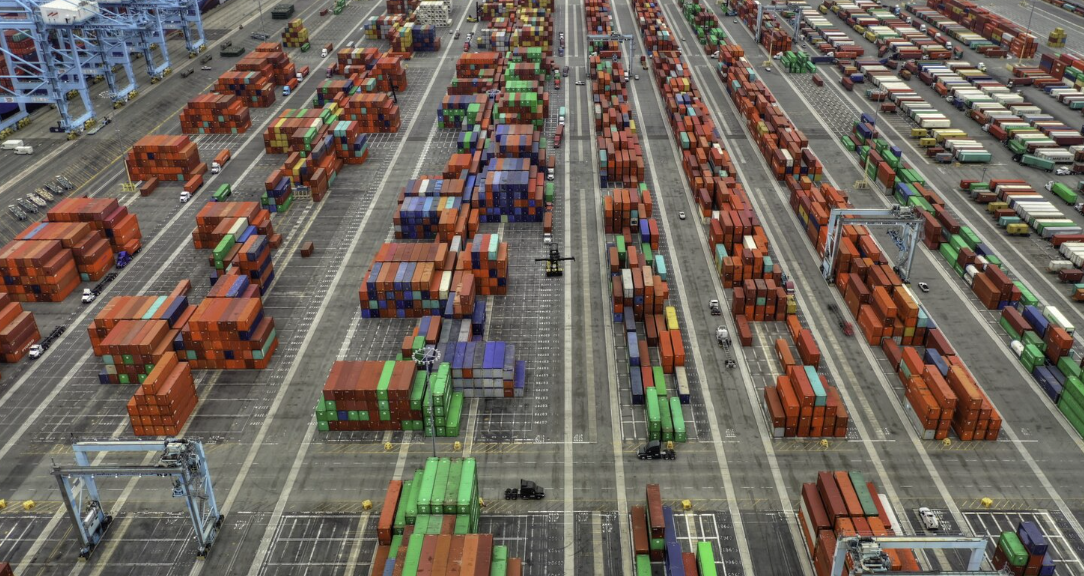
The other big source of pressure is imports. A tariff window opened, importers rushed through it, and the ports started pumping volume back into the system.
That would matter in any market. In this one, it matters more because truckload was already tightening before the inbound wave showed up.
The Port of Los Angeles has been especially loud about it:
- Imports rose 28.8%, 44.5%, and 47.6% year over year across the last week of April and first two weeks of May
- Q1 dollar-value imports were up 21.4% year over year
- Inbound ocean TEUs were running at 1,809, above the five-year average of 1,686
That freight does not stay near the water. It moves inland, competes for trucks, and adds another layer of pressure to a market that already had enough personality.
Imports are not the whole story here, but they are definitely helping make it expensive.
The supply side is on a summer diet
This is where the story gets even less fun for shippers. Demand is stronger, yes. But the bigger issue is that supply still is not healthy enough to cushion anything.
The cleanest proof is the LMI. Prices are high, capacity is low, and the gap between them is huge:
- LMI Transportation Prices hit 95.0, the second-highest reading in the index’s history
- LMI Capacity fell to 28.4, the second-lowest reading ever
- The spread between them reached a record 66.6 points
And it’s not just survey data making a scene. Payment data, tender trends, and the cost environment all say the same thing. When every signal starts nodding in agreement, it usually means the problem is real.
Relief is not idling nearby
The usual fantasy is that more trucks will show up and fix everything. Someday, maybe. Not today.
Class 8 orders are improving, but trucks ordered in Q1 do not magically appear in May. Even when they do, they still need drivers.
That’s awkward, because the driver pool is not exactly overflowing:
- About 28,000 non-domiciled CDLs had already been revoked
- The eligible foreign-driver pool was projected to shrink to roughly 6,000
- The industry has also lost 20,000 fleets since 2023
Add in fuel costs, and the floor under rates gets even sturdier.
- National gas prices were at $4.55, up 41% from pre-war levels
- Diesel climbed 55% over the quarter
- Diesel is still running about 40% above pre-war levels
So yes, the market may cool later in the year, but it increasingly looks like it would cool onto a higher floor, not crash back through it.
Put your rally caps on
Flatbed is running because of infrastructure. Reefer is running because the produce calendar is a maniac. Intermodal is catching cost-sensitive freight as truckload gets pricier.
Different causes. Same outcome. That is usually what a real cycle looks like.
The broader demand signal is just as loud:
- STRI hit 13.24 in early May, versus 5.56 a year ago
- Same-week comparisons were running about 2.5x to 3x above last year
- By mid-spring, the market was already above last year’s full-year average pace
This is not a market waiting for freight. This is a market already carrying too much of it.
Consumers are in no place to consume
Freight looks strong, but the consumer underneath it looks less strong. That’s the yellow flag behind all of this.
Energy costs are still high, inflation is heating back up, and lower-income households are already taking the hit. Freight can outrun that for a quarter or two. It cannot do it forever. Eventually, somebody has to buy the stuff in the trailer.
The strain is already showing:
- Low-income households saw real consumption fall 7%
- PCE rose 0.7% month over month and 3.5% year over year
- Core PCE was 3.2% year over year
- University of Michigan consumer sentiment fell to 49.8, a record low
So the short-term story is still tight freight and higher rates. The medium-term story is whether the consumer can keep absorbing all this without eventually tapping the brakes.
Looking ahead
Through summer, the path still points toward tight conditions:
- Imports are flowing
- Produce pressure is building
- Flatbed still has real industrial support
- Capacity still looks structurally constrained.
August may cool things somewhat, but it is more likely to slow the climb than reset the market. Then Q4 shows up with its own special set of problems.
Buckle up. We’re in for a wild ride.