Good morning, and welcome to The Cargo Club!
Today is National Cheeseburger Day, one of the few made-up holidays that deserves to be taken seriously.
It almost feels unnecessary because America has never needed encouragement to eat a cheeseburger. We didn’t become a global superpower by waiting for a designated holiday before putting cheese on beef.
The beauty of the cheeseburger is its versatility. It can be a $3 meal eaten in your car over the center console, or a $24 “chef-inspired experience” served on a wooden board with bacon jam and an unnecessary knife stabbed through the top.
The cheeseburger is reliable, difficult to ruin, and honest about what it is. It doesn’t pretend to be healthy.
So, celebrate accordingly. Order the extra patty. Add bacon. Get the fries, because pretending you were going to substitute a side salad helps no one.
– Greyson Harris
The Headlines
FMCSA Identifies 111 CDL Training Programs in Emergency Crackdown
The Federal Motor Carrier Safety Administration has finally put names to its nationwide crackdown on commercial driver training providers, identifying the schools and online operations ordered to stop training new drivers immediately.
A reconstructed roster reviewed by FreightWaves includes 111 entries across 20 states, online programs, and providers with inactive or unidentified locations.
The Aug. 31 order prohibits them from enrolling students, conducting classroom or behind-the-wheel instruction, using training facilities, and submitting certifications to FMCSA’s Training Provider Registry.
This isn’t a warning letter or an invitation to get the paperwork together. The emergency removals are already in effect.
Cracking down.
The roster contains 84 entries tied to physical locations, 23 online providers, and four listed as inactive or unknown.
Five states accounted for two-thirds of the physical-location entries:
- Texas and Pennsylvania with 13 each
The numbers require a little fine print. Several providers appear in multiple states or categories, meaning the 111 entries don’t necessarily represent 111 separate companies.
That helps explain why the roster differs slightly from the 110 schools initially cited by Transportation Secretary Sean Duffy.
Paper trail.
FMCSA built its list by comparing Training Provider Registry records with roadside inspection data for drivers cited for failing federal English-language proficiency requirements.
Each provider selected for emergency removal had trained at least 10 drivers who were later cited for English proficiency violations. Together, the providers certified more than 5,000 of those drivers, according to the agency.
The schools can request an administrative review, but the shutdown remains in place unless the order is stayed or reversed.
In other words, they can appeal, but class is still canceled.
Better shape up.
The emergency shutdown is separate from proposed-removal notices issued to more than 160 additional training providers.
Those notices followed nearly 400 investigations conducted by 175 investigators across 40 states. FMCSA reported problems including:
- Instructors without the required licenses
- Driving ranges too small for required maneuvers
- Missing training and assessment records
- Questionable classroom facilities
Drivers certified by those providers have been connected to 239 commercial vehicle-related fatalities, according to FMCSA.
Unlike the emergency removals, proposed removals don’t take effect immediately. Those providers can continue operating while submitting corrective-action plans or requesting administrative review, giving them an opportunity to fix the violations before FMCSA makes a final decision.
Trailer Trends:
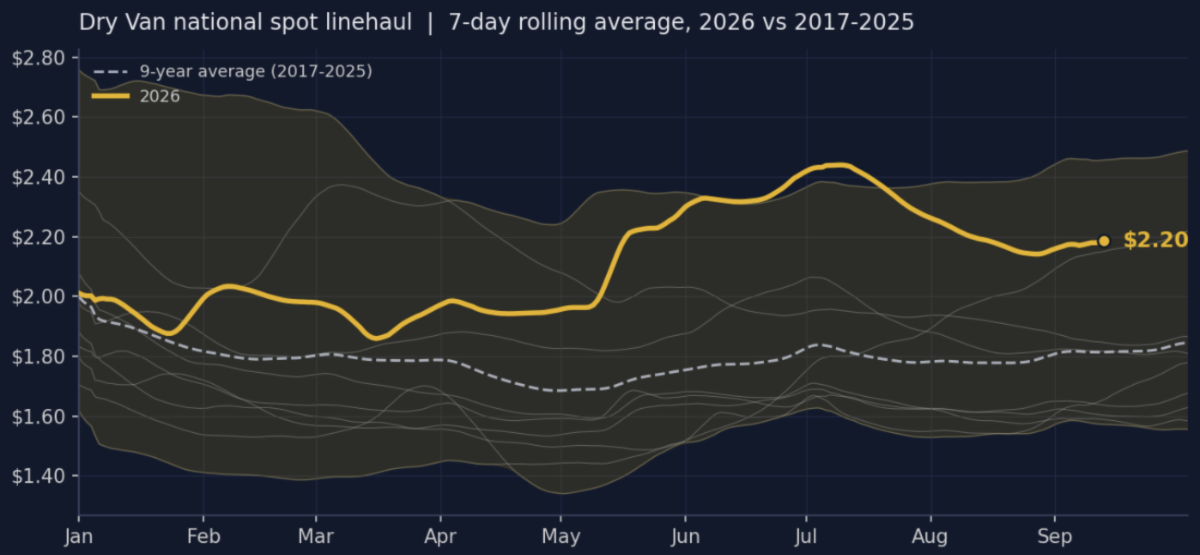
 Dry Van Rates Ease During Holiday-Shortened Week
National dry van linehaul averaged $2.20 per mile, excluding fuel, down one cent from the previous week.
Rates remained elevated:
- 34.2% higher year over year
- 21% above the nine-year seasonal average
- $0.56 per mile higher than the same week last year
Core markets hold steady.
The 10 dry van bellwether states averaged $2.94 per mile outbound, down one cent week over week, but up $0.84 year over year.
Rates remained relatively stable across major origins. The Lower Midwest led with a 0.4% weekly increase, while Florida and South Georgia recorded the steepest decline at 3%.
Holiday week reduces activity.
Load postings fell 18% from the previous week, largely reflecting the shortened workweek, but remained 23% higher year over year. Truck postings declined 14.1% and stood 40.2% below last year.
Because freight activity fell faster than available capacity, the load-to-truck ratio declined from 11.47 to 10.95. That remained more than double the 5.33 recorded during the same week in 2025.
Rates expected to hold.
DAT’s 35-day forecast projects dry van linehaul at $2.20 per mile in mid-October, unchanged from the current average and approximately $0.52 higher than last year.
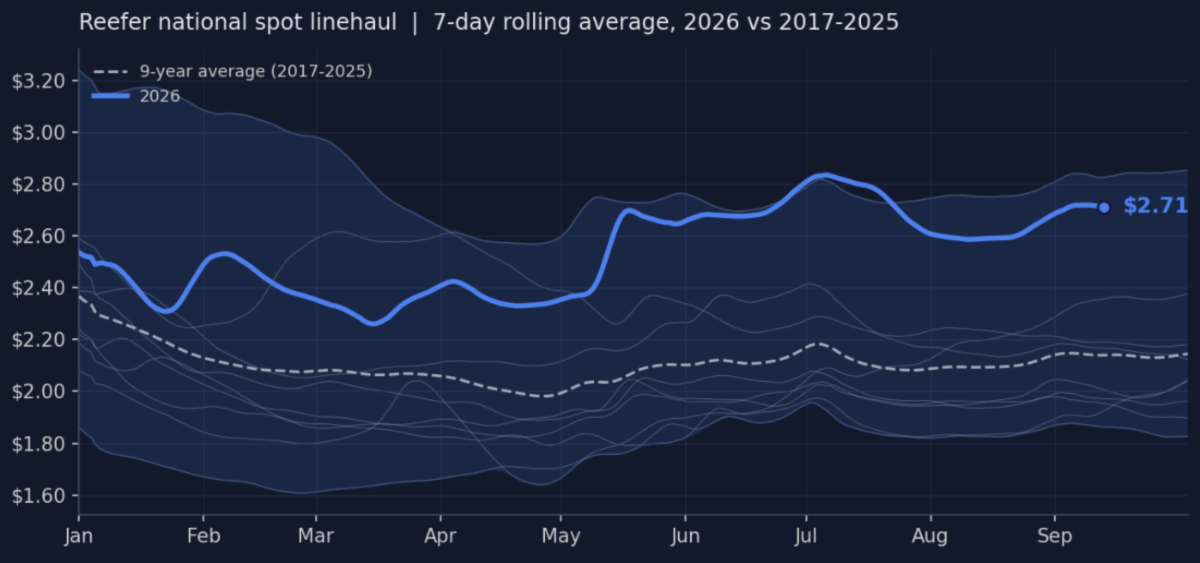
 Reefer Rates Ease as South Texas Gains Momentum
National reefer linehaul averaged $2.71 per mile, excluding fuel, down two cents from the previous week.
Rates remained elevated:
- 35% higher year over year
- 26.6% above the nine-year seasonal average
- $0.70 per mile higher than the same week last year
Core markets soften.
The 10 reefer bellwether states averaged $3.64 per mile outbound, down three cents week over week, but up $1.03 year over year.
The Pacific Northwest led major origins with a 2.1% weekly increase, while several other regions declined. The Upper Midwest fell 3.7%, and the South Central region dropped 6.4%.
South Texas gains momentum.
Produce rates from South Texas strengthened across several eastern and central lanes, led by a 14% increase into Boston. Rates into Miami, Dallas, Baltimore, and Chicago also climbed as Mexico crossings through the Rio Grande Valley gained momentum.
California moved in the opposite direction, with vegetable lanes generally softening. Washington tree fruit remained the highest-paying produce freight in the country, despite showing little weekly movement.
Holiday week slows movement.
Reefer load postings fell 22.3% from the previous week, while truck postings declined 12.1%. That pushed the load-to-truck ratio down from 21.49 to 19.
Capacity nevertheless remained considerably tighter than last year, when the ratio stood at 8.84.
Rates expected to ease.
DAT’s 35-day forecast projects reefer linehaul at $2.65 per mile in mid-October, six cents below the current average, but approximately $0.57 higher than last year.
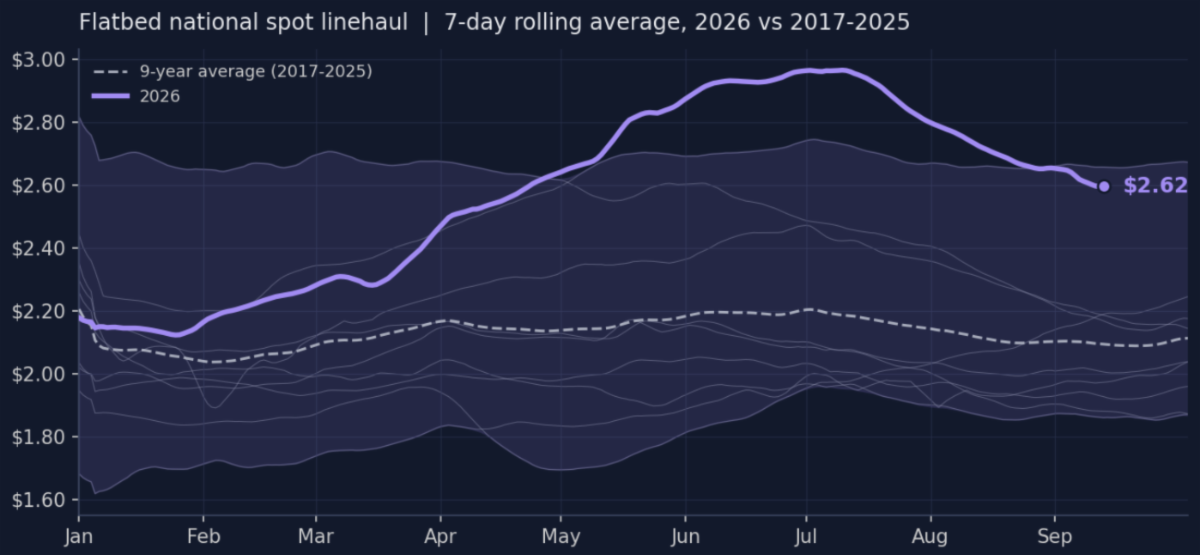
 Flatbed Rates Fall as Truck Supply Shrinks
National flatbed linehaul averaged $2.62 per mile, excluding fuel, down five cents from the previous week.
Rates remained near the top of the historical range:
- 29.8% higher year over year
- 24.3% above the nine-year seasonal average
- $0.60 per mile higher than the same week last year
Core markets decline.
The 10 flatbed bellwether states averaged $3.17 per mile outbound, down $0.13 week over week, but up $0.66 year over year.
Nearly every major origin recorded lower rates during the shortened week. California posted the steepest decline at 7.7%, followed by Florida and South Georgia at 6.2%. The Upper Atlantic was the only region to avoid a decline.
Capacity tightens despite lower volume.
Load postings fell 11.6% from the previous week, while truck postings declined 16.3%. With equipment leaving the market faster than freight, the load-to-truck ratio increased from 36.44 to 38.47.
Capacity remained considerably tighter than last year, with truck postings down 38.6% and the load-to-truck ratio well above the year-ago mark of 21.29.
Agricultural demand remains weak.
Falling farm equipment sales continue to create uncertainty for open-deck demand. U.S. tractor sales declined 10.9% year over year in July, while combine sales fell 5.3%.
The weakness was particularly pronounced among four-wheel-drive tractors, which generate some of the heaviest flatbed, step-deck, and removable gooseneck moves. Sales in that category fell 38.7% year over year.
Rates expected to ease.
DAT’s 35-day forecast projects flatbed linehaul at $2.59 per mile in mid-October, three cents below the current average, but approximately $0.54 higher than last year.
Keeping Up With KCH:
Truck Parking Sucks - Let's Fix That.
KCH is teaming up with Truck Parking Club to help drivers find safe, legal parking, without the scavenger hunt.
Use code KCH25 at checkout for $25 off your next reservation.
Less time circling the lot. More time doing literally anything else.
Book Our Loads on Highway's TFX
We’re now posting freight on the Trusted Freight Exchange (TFX), a secure, Highway-powered network made for verified carriers like you.
It’s built right into Highway, free to use, and designed to connect you with quality freight fast.
Every KCH load on TFX is:
- Verified: posted by trusted shippers and brokers.
- Ready to roll: book it instantly and get moving.
With TFX, you skip the back-and-forth and get straight to hauling.
Get your SYLTD t-shirt
Support Your Local Truck Driver T-Shirt
$39.95
Connect with us on our social pages!