Good morning, and welcome to The Cargo Club!
Today is National Comic Book Day, which is convenient for me because I have spent a completely reasonable portion of my life thinking about fictional people in brightly colored outfits punching each other through buildings.
I’ve always loved comics, which probably explains several things about my personality that are better left unexplored in a professional newsletter.
But the thing I’ve always liked most about superheroes isn’t really the powers, costumes, or the fact that apparently every major American city has an alarming number of abandoned warehouses available for supervillain activity.
It’s that the best comic stories usually aren’t about superheroes at all.
They’re about us.
The X-Men have always been my favorite example. Sure, they can shoot lasers out of their eyes, control the weather, walk through walls, and, in Rogue’s case, accidentally ruin your entire afternoon with a handshake.
But underneath all of that, the story has always been about what happens when society encounters people who are different.
Fear turns into suspicion, suspicion turns into hatred, and eventually someone decides the people repeatedly saving the world are actually the problem.
Which feels a little ungrateful, frankly.
Imagine watching Rogue help prevent a catastrophe for the sixth time and still thinking, “Yeah, but I don’t know about these mutants.”
Buddy, she just threw a Sentinel through a building. Maybe send a thank you card.
That’s what comics do so well. They take prejudice, power, corruption, responsibility, grief, identity, and all the other complicated things humans have been arguing about forever, then add capes and occasionally a giant space robot.
Somehow, that makes everything easier to understand.
So, celebrate Comic Book Day however you see fit. Read an old favorite, pick up something new, or spend 45 minutes explaining to someone why your preferred fictional billionaire could absolutely beat their preferred fictional billionaire in a fight.
Just remember: if your takeaway from X-Men is that the mutants are the problem, we may have consumed very different media.
– Greyson Harris
The Headlines
Mexican Drivers Accuse U.S. Recruiter, Carriers of Forced Labor
A federal lawsuit is raising serious questions about how foreign truck drivers are recruited to work in the U.S., with dozens of Mexican drivers alleging they were promised legal employment and immigration assistance before becoming trapped in a system of fees, withheld documents, and threats.
Attorneys now represent at least 45 Mexican commercial drivers who say they had similar experiences involving California-based Omega Compliance Solutions and a group of U.S. trucking companies. Twenty-nine of those drivers are currently plaintiffs in Doe v. Omega Compliance Solutions LLC et al., a case filed in December 2025 in the U.S. District Court for the Southern District of California.
The allegations have not been proven in court.
Promises of visas and legal work
According to the amended complaint, Omega and recruiters working on its behalf targeted professional drivers in Mexico between roughly 2022 and 2025, promising lawful U.S. employment, work authorization, employment-based visas, and, in some cases, eventual permanent residency.
Drivers allege they were given immigration “case numbers,” information suggesting their sponsorship was moving forward, and requests for thousands of dollars in activation or visa-processing fees before being assigned to U.S. carriers.
One driver alleges he was told Omega had secured an EB-3 immigration case for him and that paying a $3,000 activation fee would put him on the path toward a work permit and residency. According to the complaint, he later surrendered his passport and was allegedly warned that refusing loads or leaving the program could cost him everything and result in being reported to immigration authorities.
Drivers allege documents were withheld
The plaintiffs also claim some passports and I-94 immigration documents were retained after drivers began working.
According to the lawsuit, drivers faced deductions for expenses including legal services, insurance, taxes, fuel, truck maintenance, and penalties. Those who questioned the arrangement, requested their documents back, or attempted to leave allegedly faced threats of deportation, financial consequences, or blacklisting.
The lawsuit argues that those practices amounted to forced labor and trafficking under federal law. Plaintiffs have also brought claims under the Racketeer Influenced and Corrupt Organizations Act, Fair Labor Standards Act, and California labor laws, alleging unpaid wages, unlawful deductions, and worker misclassification.
Carriers dispute the allegations
The amended complaint names South Star Logistics, Trius Trucking, New Legend, B&B Transport, A&I Transport, Diesel Direct, and Diesel Direct West among the defendants. The plaintiffs do not claim that every carrier participated in every alleged act, instead arguing that different companies played different roles in recruiting, onboarding, payroll, dispatch, and supervision.
Several defendants have challenged the case. Trius Trucking, B&B Transport, Diesel Direct, and Diesel Direct West have filed motions seeking dismissal, while A&I Transport has acknowledged using drivers supplied by Omega but denied knowingly employing drivers without lawful U.S. work authorization.
South Star Logistics has separately filed a crossclaim against Omega and its principals, Henry and Rick Gamino. South Star denies participating in trafficking, forced labor, immigration fraud, or wage theft and says its agreement placed responsibility for recruiting, employment compliance, payroll, and worker eligibility on Omega.
The carrier argues that it relied on Omega’s representations that those requirements were being handled properly. Those claims also remain unresolved.
The case is still growing
The lawsuit originally involved 22 drivers before seven more were added in January. Attorneys for the plaintiffs now say they represent at least 45 drivers reporting substantially similar experiences and could seek to add more plaintiffs or defendants as the investigation continues.
Trailer Trends:
 Dry Van Market Shows Signs of Life
Dry van spot rates continued to ease last week, but the broader freight market finally delivered a milestone worth noting.
The Cass Freight Index reported its first year-over-year increase in shipments since January 2023, ending a 42-month stretch of declines.
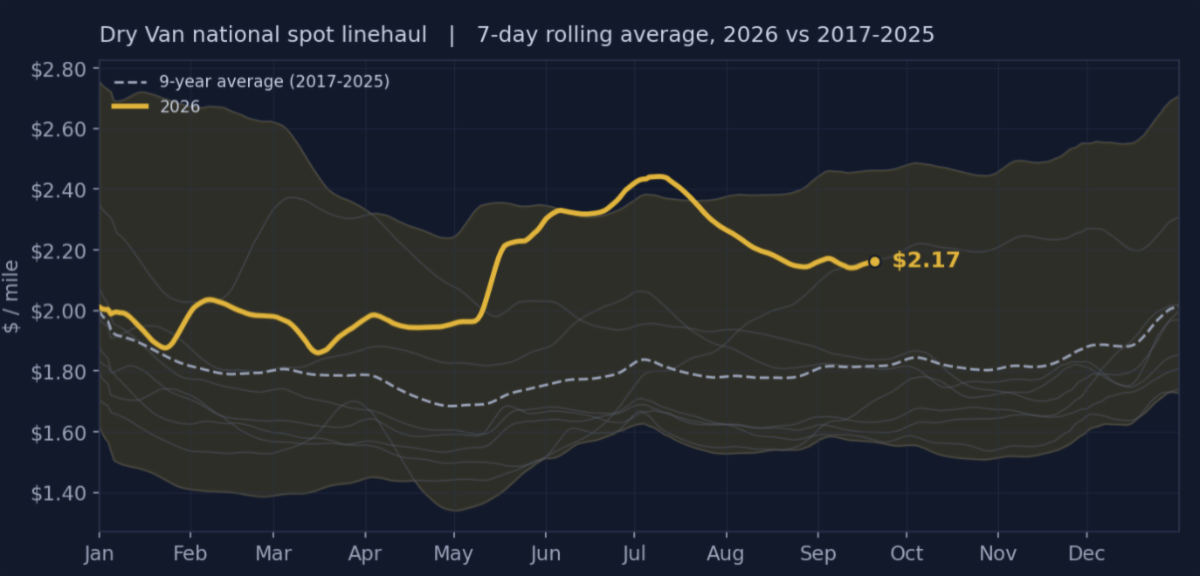
DAT’s national dry van linehaul rate slipped to $2.17 per mile, while capacity remained considerably tighter than a year ago.
Key rate comparisons
Regional rates remained strongest in the Great Lakes at $2.66 per mile and Ohio River region at $2.64. California slipped 1.5% to $2.44, while most southern markets softened, including Florida-South Georgia, which fell 4.1% to $1.42 per mile.
- National dry van: $2.17/mile, down $0.03, or 1.2%, week over week
- Year over year: Up $0.53, or 32.8%
- Vs. nine-year seasonal average: Up $0.36, or 19.7%
- Bellwether states: $2.96/mile, essentially flat week over week and up 41.5% year over year
Freight volumes finally turn positive
The Cass Freight Index shipments component increased 2.1% year over year in August, its first annual gain in three and a half years and the end of the longest downturn in the index’s history. Shipments also jumped 5.6% from July, or 5.0% on a seasonally adjusted basis.
Cass cautioned that the increase largely reversed declines from June and July, so it’s too early to call it a major demand rebound.
Truckload pricing continued to show more strength than volumes. The Cass Truckload Linehaul Index rose 11.3% year over year and 0.7% from July, reflecting continued upward pressure across the much larger contract market even as spot rates have eased.
Outlook
DAT expects dry van spot rates to remain relatively steady over the next month, forecasting roughly $2.15 per mile by late October. That would still put rates about $0.46 per mile above the same point last year.
 Reefer Rates Rise as Fall Produce Markets Heat Up
Reefer spot rates edged higher last week as produce demand strengthened, particularly in California citrus and Pacific Northwest tree fruit.
Key rate comparisons
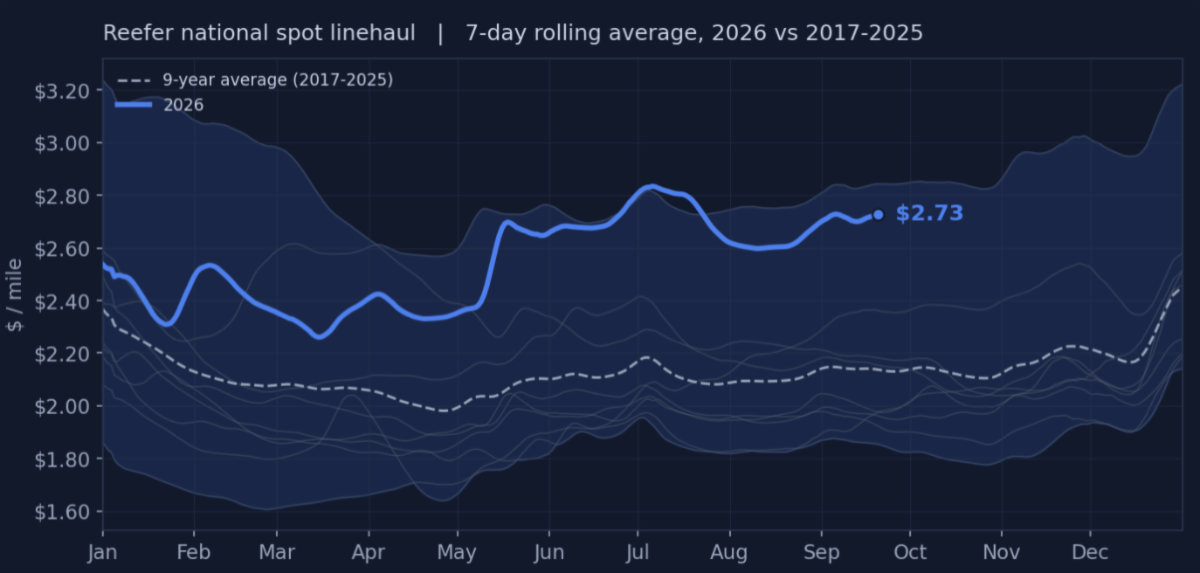
- National reefer: $2.73/mile, up $0.02, or 0.7%, week over week
- Year over year: Up $0.75, or 37.9%
- Vs. nine-year seasonal average: Up $0.60, or 27.9%
- Load-to-truck ratio: 19.06 as produce demand firmed
California citrus reprices sharply
South and Central California citrus markets broke higher after several quiet weeks, with every reported destination posting a weekly increase. Citrus lanes are now running 35% to 72% above last year, with Chicago up 23% for the week and long-haul moves into Boston and Miami among the most expensive.
California’s coastal vegetable markets, meanwhile, remained largely flat.
Yakima tree fruit runs hot
Apple and pear harvest freight out of Washington’s Yakima Valley also moved sharply higher. Every reported lane ran 48% to 84% above last year, with several East Coast moves reaching between $12,000 and $14,800 at the top of the range.
Outbound Yakima spot rates averaged $2.90 per mile, a four-year high and already 16% above the typical late-November level over the past four years.
Outlook
DAT’s 35-day forecast calls for reefer spot rates to average around $2.69 per mile, with relatively little movement expected through October. That would still leave rates roughly $0.61 per mile above the same period last year as fall produce demand continues supporting the market.
 Flatbed Rates Hold as Housing Outlook Weakens
Flatbed spot rates barely moved last week, but underlying capacity tightened considerably as freight volumes rebounded after Labor Day.
Key rate comparisons
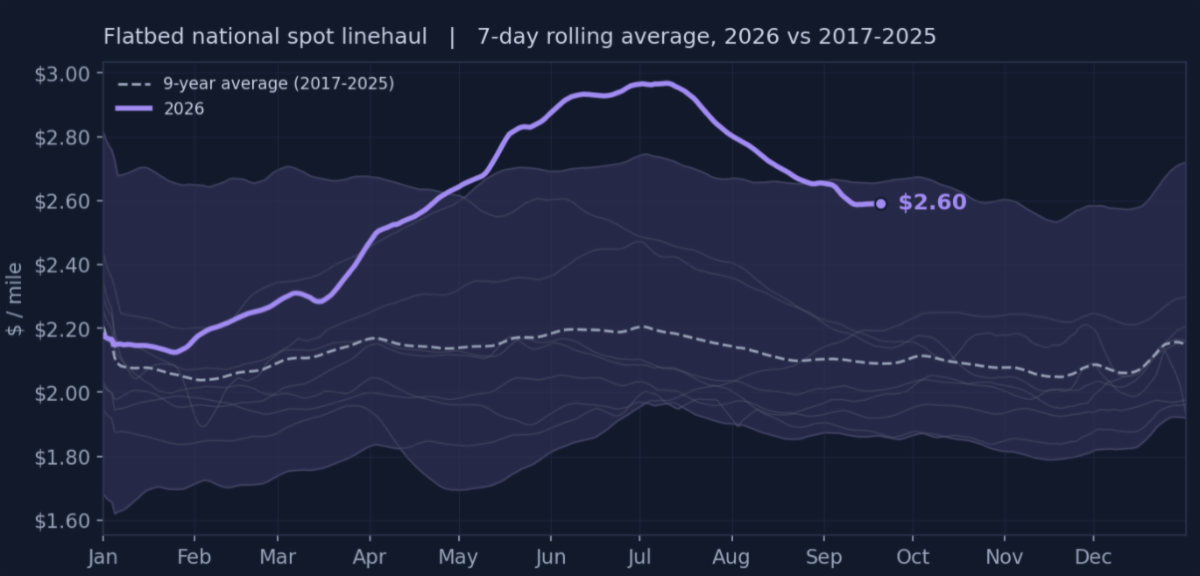
- National flatbed: $2.60/mile, down $0.01, or 0.5%, week over week
- Year over year: Up $0.59, or 29.2%
- Vs. nine-year seasonal average: Up $0.51, or 24.6%
- Bellwether states: $3.25/mile, up 1.9% week over week and 29.3% year over year
Housing’s pipeline starts to soften
Housing remains an important source of flatbed demand, and the latest construction data points to some weakness further down the pipeline.
Total housing starts fell 2.6% in August to an annualized 1.275 million units, while building permits declined 2.7% to 1.394 million. Single-family starts provided a bright spot, jumping 7.6%, but single-family permits slipped 1.8%, suggesting builders may pull back on future projects.
Flatbed capacity gets tighter
Flatbed load posts surged 25.1% week over week and were 18.8% higher than last year, putting volume about 11.4% above its pre-Labor Day August pace. Equipment posts rose 14.8% for the week but remained 24% below last year, pushing the load-to-truck ratio to 40.47.
Flatbed load-post volume was still 16% above the 2025 weekly average and 39% above the long-term average for Week 38.
Southern markets lead the way
The Southeast and Ohio River regions tied for the highest average outbound rate at $3.20 per mile, rising 2.5% and 2.1%, respectively. Florida and South Georgia posted the largest weekly percentage increase, climbing 4% to $2.31, while California and the Lower Mountain region were the only major origins to decline.
All 10 leading origin markets remained at least 20% above their year-ago rates.
Outlook
DAT’s 35-day forecast has flatbed spot rates easing to around $2.55 per mile by late October. Even with that expected decline, rates would remain roughly $0.50 per mile above the same point last year, keeping flatbed well ahead of its 2025 pace heading into the fourth quarter.
Keeping Up With KCH:
Truck Parking Sucks - Let's Fix That.
KCH is teaming up with Truck Parking Club to help drivers find safe, legal parking, without the scavenger hunt.
Use code KCH25 at checkout for $25 off your next reservation.
Less time circling the lot. More time doing literally anything else.
Book Our Loads on Highway's TFX
We’re now posting freight on the Trusted Freight Exchange (TFX), a secure, Highway-powered network made for verified carriers like you.
It’s built right into Highway, free to use, and designed to connect you with quality freight fast.
Every KCH load on TFX is:
- Verified: posted by trusted shippers and brokers.
- Ready to roll: book it instantly and get moving.
With TFX, you skip the back-and-forth and get straight to hauling.
Get your SYLTD t-shirt
Support Your Local Truck Driver T-Shirt
$39.95
Connect with us on our social pages!