
Good morning, and welcome to The Cargo Club!
Today is National Hawaiian Shirt Day, which means we’ve officially reached the bargain-bin portion of the late-summer holiday calendar.
Sure, today gives you a legitimate excuse to bust out your favorite floral garment, but the real veterans have been rocking the divorced-dad-at-an-all-
It’s me. I’m the divorced dad.
There’s just something special about a Hawaiian shirt. The second you put one on, you’re telling the room, “I’m here to have a good time, and there is at least a 40% chance I have a Salt Life sticker on the back of my Ford F-150 despite living seven hours from the nearest coastline.”
It’s less of a shirt and more of a lifestyle declaration.
You don’t even have to visit Hawaii to appreciate the aesthetic.
Just find a polyester button-up with enough flowers to attract a family of hummingbirds, leave the top two buttons open with absolutely no justification for doing so other than showing off your chest hair and gold chain, head to your nearest dive bar to order a drink with an unnecessary piece of fruit in it, and let the good times find you.
Summer’s almost over. Dress accordingly.
– Greyson Harris
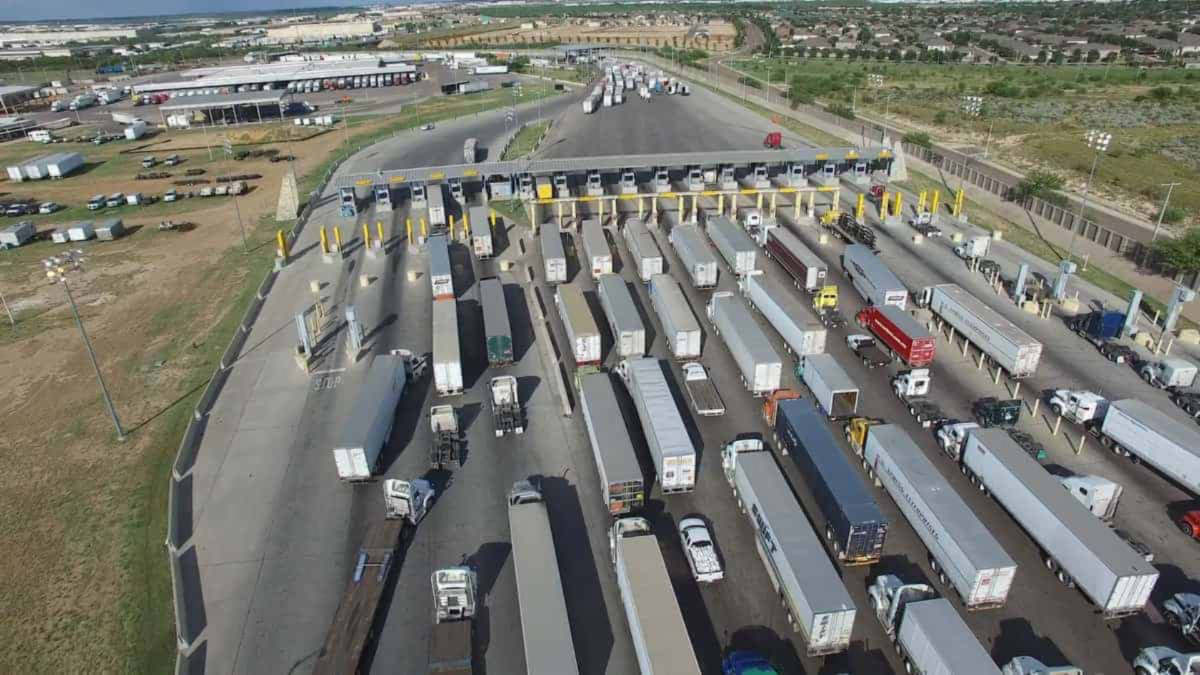
Mexico’s export economy apparently missed the memo that everyone was supposed to be nervous.
Despite tariff uncertainty, tighter immigration enforcement, stricter cross-border rules and manufacturers reconsidering where they build things, Mexican exports surged 34.4% year over year in June, according to C.H. Robinson.
That marked the fifth consecutive month of double-digit growth and pushed exports up 24.6% through the first half of 2026.
The U.S. remains Mexico’s favorite customer by a margin that would make Amazon jealous.
Roughly 84% of Mexico’s non-oil exports went to the United States during the first half of the year. In June alone, non-oil exports to the U.S. jumped 35.8% year over year, compared with 25% growth to the rest of the world.
Manufacturing has been doing most of the heavy lifting, with exports in the sector rising 35.3% in June. Electrical and electronic equipment, along with food and beverage shipments, were among the biggest contributors.
For trucking, that means one thing: northbound freight is still king.
C.H. Robinson said lanes out of Coahuila and Nuevo León continue to see higher load-to-truck ratios than southbound lanes, allowing carriers to remain selective and keep rates firm.
A few numbers worth taping to the refrigerator:
Laredo has cooled a bit recently, however. Volumes at the nation’s busiest international truck gateway fell 6.7% week over week in August, while rejection rates also declined, suggesting capacity has loosened somewhat.
The bigger problem is finding enough drivers who can actually move all this stuff across the border.
C.H. Robinson said stricter enforcement of B-1 visa rules and English-language requirements is reducing the number of Mexican drivers willing or able to operate in the U.S.
At the same time, authorities are applying greater scrutiny to shipping paperwork, cargo values, declared weights and securement.
The changes are making border crossings slower and carriers pickier about the freight they accept. That matters because roughly 81% of Mexico’s land freight moves by truck, leaving the industry with relatively few ways to shrug off a driver-capacity problem.
C.H. Robinson said carriers are increasingly willing to reward shippers that make compliance and operations easy, even if those shippers aren’t necessarily offering the highest rate.
The automotive sector has traditionally been one of the engines powering U.S.-Mexico freight, but that engine is idling a little rougher this year.
Mexican light-vehicle production slipped 0.4% during the first half of 2026, while exports increased just 1.4%. Heavy-duty truck production and exports both fell by double digits.
But while automotive freight cools, another category is taking its turn behind the wheel. Computing equipment has now surpassed automotive products as Mexico’s largest export category to the U.S.
Mexico now supplies nearly 17% of all U.S. imports, making it America’s largest trading partner.
The pipeline still looks full.
Perhaps the strongest sign that Mexico’s export boom has more room to run is buried one step earlier in the supply chain.
Imports of intermediate goods, the raw materials and components manufacturers use to build finished products, surged 30.9% year over year in June and now account for roughly 80% of Mexico’s total imports.
C.H. Robinson believes that could support continued export growth through the rest of the year, which would keep cross-border freight demand elevated.

The used-truck market may finally be waking up from its freight-recession-induced coma.
Ryder System CEO John Diez expects used truck and tractor prices to rise at least 10% year over year in 2027, following an increase of roughly 5% so far in 2026.
The reason is fairly simple: spot rates are recovering, more buyers are creeping back into the market and, as usual, buying a truck is about to become more expensive at precisely the moment fleets start feeling comfortable buying trucks again.
It’s alive!
Ryder is already seeing the beginnings of the turnaround.
Used tractor prices increased 6% year over year during the second quarter, while used truck prices rose 3%. Compared with the first quarter, tractor prices jumped 7% and truck prices increased another 3%.
Sales volume remains below last year’s levels, but momentum improved during the spring:
Diez described the current environment as the “early innings” of a used-equipment recovery, largely driven by improvement in the spot freight market.
Let’s not get too carried away.
The recovery isn’t moving in a perfectly straight line.
J.D. Power reported that average used Class 8 retail prices fell 3.4% from June to July and were still down 6.2% year over year.
That might seem slightly inconvenient for the whole “prices are going up” argument, but used-equipment markets tend to turn gradually. Ryder is betting that stronger freight rates and tightening equipment supply will eventually push pricing higher as more carriers return to the market.
New model, new price.
Fleets are still waiting to see exactly what model-year 2027 equipment will cost as manufacturers digest the EPA’s latest proposed nitrogen oxide emissions rules.
Diez expects those regulations to produce a high-single-digit to low-double-digit increase in new-truck pricing.
The EPA has estimated that proposed changes could save buyers as much as $6,000 per vehicle through lower emissions-related warranty costs. Manufacturers, meanwhile, have previously floated potential price increases around $20,000 before suggesting longer warranty provisions could cut that increase roughly in half.
So the precise number remains TBD, which is always comforting when the item in question already costs roughly as much as a house in certain parts of the country.
More reload than rebuild.
Don’t mistake rising equipment prices for fleets preparing another truck-buying bonanza, though.
Diez said carriers still aren’t meaningfully expanding their fleets because freight volumes haven’t increased enough to justify it. Most current purchases are replacement equipment after carriers spent much of the prolonged freight downturn postponing purchases and squeezing a few more miles out of existing tractors.
The good news for buyers is that manufacturers may stagger their introduction of 2027 engines rather than flipping the entire industry to the new equipment at once. Cummins has already indicated it plans to take that approach, while International parent Traton Group has said it is considering something similar.
But between a recovering spot market, aging fleets and potentially significant increases in new-equipment prices, the used-truck bargain bin may be approaching closing time.
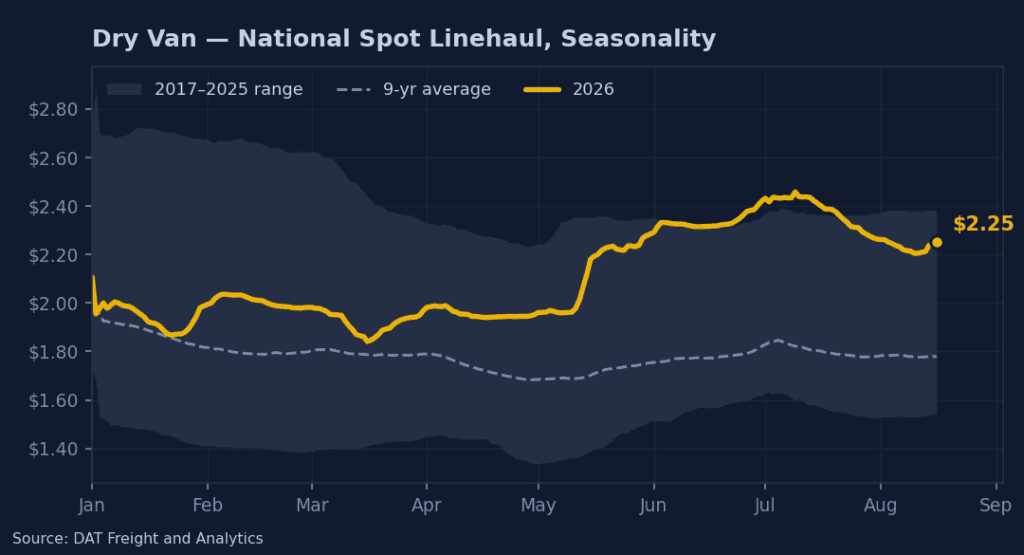
Dry van spot rates declined again last week as late-summer freight volumes continued to soften, but pricing remains well above both last year and historical seasonal norms.
National dry van linehaul averaged $2.25 per mile, down three cents, or 1.3%, from the prior week. Despite the weekly decline, rates remained near the top of the historical range:
The 10 bellwether states averaged $2.97 per mile outbound, down three cents from the previous week but still 44% higher year over year.
Those states accounted for 35.5% of all outbound dry van loads, remaining right around their recent baseline. The top 10 origin states handled 87.6% of all outbound loads during the week.
Load postings declined 1.5% from the previous week, while available truck postings fell by a smaller 0.8%. With freight demand easing slightly faster than capacity, the load-to-truck ratio slipped from 10.05 to 9.98.
Even after the decline, the ratio remains significantly tighter than last year, when it stood at just 5.77. Load postings are currently 27.2% higher year over year, while truck postings are down 26.4%.
DAT’s 35-day forecast puts dry van spot linehaul at approximately $2.24 per mile by mid-September, essentially unchanged from current levels.
The forecast carries a range of roughly eight cents in either direction, the widest uncertainty band among the major equipment types. Even at the projected $2.24 level, rates would remain about $0.60 per mile above where they stood at the same point last year.
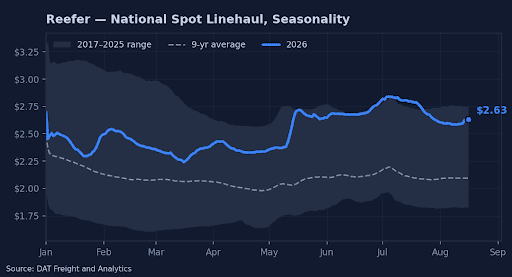
Reefer spot rates were nearly unchanged last week as the market continued to ease from its summer peak, but pricing remains well above both last year and historical seasonal norms.
The 10 bellwether states averaged $3.60 per mile outbound, down one cent from the previous week but still 40.6% higher year over year.
Those states accounted for 41% of all outbound reefer loads, slightly above their typical 38% to 40% range. The top 10 origin states handled 84% of all outbound reefer loads during the week.
Most major origins softened as summer freight volumes continued to fade, although the Upper Atlantic moved in the opposite direction with a 3.8% week-over-week increase.
Load postings declined 6% from the previous week, while available truck postings fell 5.7%. With freight demand easing slightly faster than capacity, the load-to-truck ratio dipped from 18.66 to 18.62.
Despite the weekly decline, the market remains considerably tighter than last year. Load postings are up 25.1% year over year, while truck postings are down 30.5%, leaving the load-to-truck ratio well above the 10.34 recorded a year ago.
DAT’s 35-day forecast puts reefer spot linehaul at approximately $2.61 per mile by mid-September, just two cents below current levels.
The forecast carries a range of roughly six cents in either direction, the narrowest uncertainty band among the major equipment types. At the projected $2.61 level, reefer rates would remain about $0.61 per mile above where they stood at the same point last year.
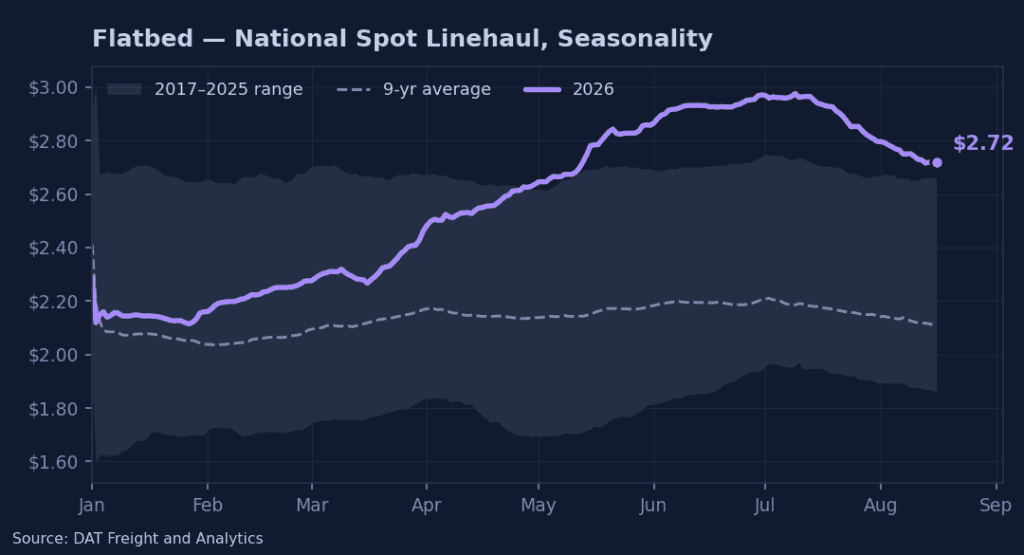
National flatbed linehaul averaged $2.72 per mile, down seven cents, or 2.4%, from the prior week. Even after the pullback, rates remain near the top of the historical range:
The 10 bellwether states averaged $3.43 per mile outbound, down seven cents, or 2%, from the previous week but still 37.8% higher year over year.
Those states accounted for 52.3% of all outbound flatbed loads, right in the middle of their typical 51% to 53% range. The top 10 origin states handled 87.3% of all outbound loads during the week.
Every major origin posted a week-over-week decline as summer volumes softened. The Great Lakes held up best, but rates there still fell 3.3%.
Load postings declined 6% from the previous week, while available truck postings fell by a smaller 2.2%. With freight demand easing faster than capacity, the load-to-truck ratio dropped from 35.85 to 34.45.
Even with that decline, conditions remain much tighter than a year ago. Load postings are up 25.9% year over year, while truck postings are down 25.3%, leaving the load-to-truck ratio well above the 20.43 recorded last year.
DAT’s 35-day forecast puts flatbed spot linehaul at approximately $2.65 per mile by mid-September, seven cents below current levels.
The forecast carries a range of roughly seven cents in either direction. At the projected $2.65 level, flatbed rates would still sit about $0.62 per mile above where they stood at the same point last year.

Truck Parking Sucks – Let’s Fix That.
KCH is teaming up with Truck Parking Club to help drivers find safe, legal parking, without the scavenger hunt.
Use code KCH25 at checkout for $25 off your next reservation.
Less time circling the lot. More time doing literally anything else.

We’re now posting freight on the Trusted Freight Exchange (TFX), a secure, Highway-powered network made for verified carriers like you.
It’s built right into Highway, free to use, and designed to connect you with quality freight fast.
Every KCH load on TFX is:
With TFX, you skip the back-and-forth and get straight to hauling.

Designed for shippers who want straightforward market insight and smarter freight strategies.