Good afternoon, and welcome to The Cargo Club!
I went to my first Atlanta Braves playoff game last night, and I can now confirm that regular-season baseball is basically a church service by comparison.
Playoff baseball is three straight hours of yelling, standing, sitting, standing again, high-fiving complete strangers, and developing deeply personal opinions about people from Philadelphia you have never met.
I have never high-fived that many people in my life. By the seventh inning, I was greeting random men like we had served together overseas.
I was covered in beer that I did not purchase, my voice was hanging on by a thread, and my right arm had logged enough tomahawk chops to qualify as an upper-body workout.
And that’s the beauty of playoff sports. For one night, every normal social boundary disappears.
A 52-year-old accountant named Greg can grab you by the shoulders after a home run, scream directly into your face, and somehow you’re both completely fine with it. You may even miss Greg when it’s over.
Go Braves. Phillies suck. Happy Friday.
– Greyson Harris
The Headlines
New Bill Targets Cabotage, CDL Eligibility and English Proficiency
Congress is taking another swing at trucking enforcement, and this one comes with some very large numbers attached.
Rep. Brandon Gill, R-Texas, introduced Barron’s Law on Sept. 28, a bill that would require standardized English-proficiency testing for CDL applicants, tighten work-authorization requirements, crack down on chameleon carriers, and dramatically increase penalties for illegal cabotage.
The bill is named for Barron Ritchey, an 8-year-old Texas boy who was killed in 2023 when a wheel hub and dual tires separated from a tractor-trailer and struck the SUV he was riding in. According to Gill’s office, the driver involved had overstayed his B-1 visa by roughly six months.
English testing moves to the licensing counter
Federal regulations already require interstate commercial drivers to be able to read and speak English well enough to understand road signs, communicate with officials, and complete required records. FMCSA has also stepped up roadside enforcement, with drivers who fail English-language assessments potentially being placed out of service.
Barron’s Law would take that a step further by making an FMCSA-approved standardized English test a requirement for obtaining or renewing a CDL. Applicants would have to demonstrate that they can understand road signs and safety instructions, respond to spoken directions and emergency communications, and complete required logs and reports.
The proposal would also require CDL applicants to be U.S. citizens, lawful permanent residents, or otherwise federally authorized to work in a job involving commercial vehicle operation. CDL records would include an indicator confirming that eligibility, though the underlying immigration documents would not be stored in the record.
Carriers would have more skin in the game
Under the proposal, carriers that knowingly employ or contract with an ineligible driver could face civil penalties of at least $25,000 per violation. If that conduct results in serious injury or death, the minimum penalty would rise to $100,000.
The bill would also strengthen enforcement against so-called chameleon carriers, companies that reappear under new names or affiliated entities after losing their operating authority or facing enforcement action.
DOT could deny registration to certain carriers tied to a company whose authority had been revoked within the previous three years, while intentionally hiding those relationships could bring fines of up to $25,000, up to a year in prison, or both.
Cabotage violations could get very expensive, very quickly
Foreign-domiciled carriers generally may haul international freight into the U.S., but they cannot simply begin moving domestic point-to-point loads once they’re here. Barron’s Law would impose penalties of up to $100,000 per vehicle, per day for knowing violations of those cabotage restrictions.
The proposal would also create a pilot program using GPS, electronic logging device data, and geofencing at major land ports of entry to identify foreign carriers suspected of making illegal domestic moves after crossing the border. Exactly which ports would participate, how the data would be collected, and how long it would be retained have not yet been detailed publicly.
Trailer Trends:
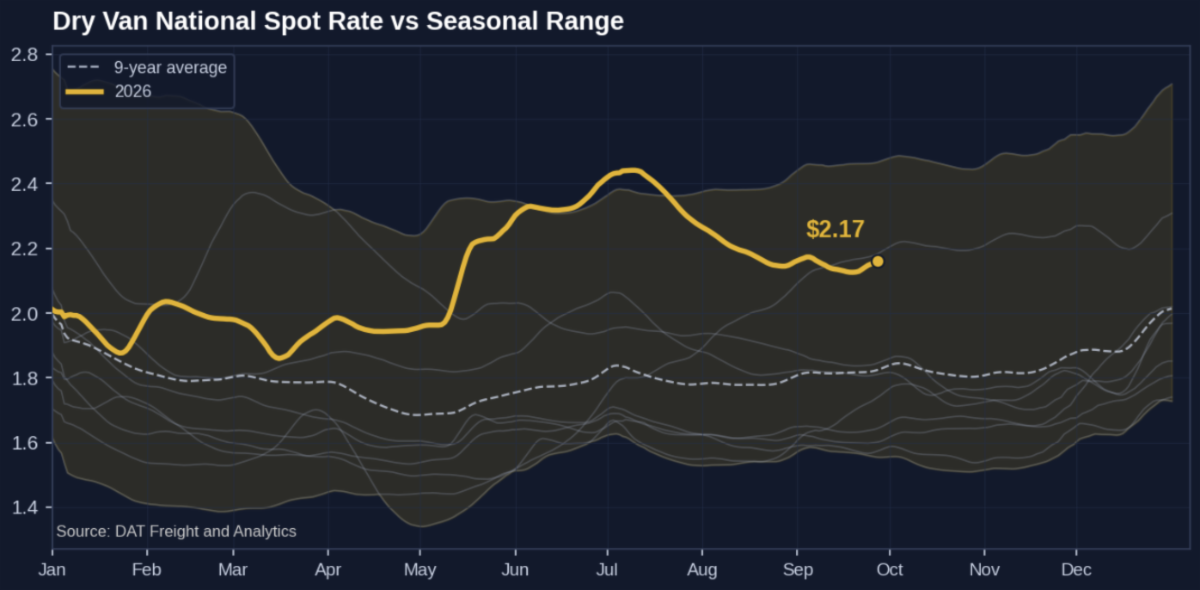
 Dry Van Market Tightens as Truck Supply Shrinks
Dry van rates held steady last week, but the underlying market continued to tighten as available truck capacity shrank.
- National average: $2.17/mile
- Vs. nine-year average: +18.5%
Capacity keeps tightening
Van load posts increased 1.9% from the previous week and were nearly 30% higher than a year ago. At the same time, truck posts fell another 2.9% and remained 25.8% below last year, pushing the load-to-truck ratio from 10.86 to 11.40.
California bucks the trend
Across DAT’s bellwether states, outbound rates slipped just one cent to $2.91 per mile, still 38.7% above last year.
California was the standout among the largest origin regions, climbing 2.1% to $2.49 per mile, while most other major markets were flat or slightly lower. The Great Lakes remained the highest-priced major origin at $2.66 per mile.
Looking ahead
DAT’s 35-day forecast has dry van spot rates easing slightly to around $2.14 per mile by late October. Even with that modest decline, rates would remain well ahead of last year.
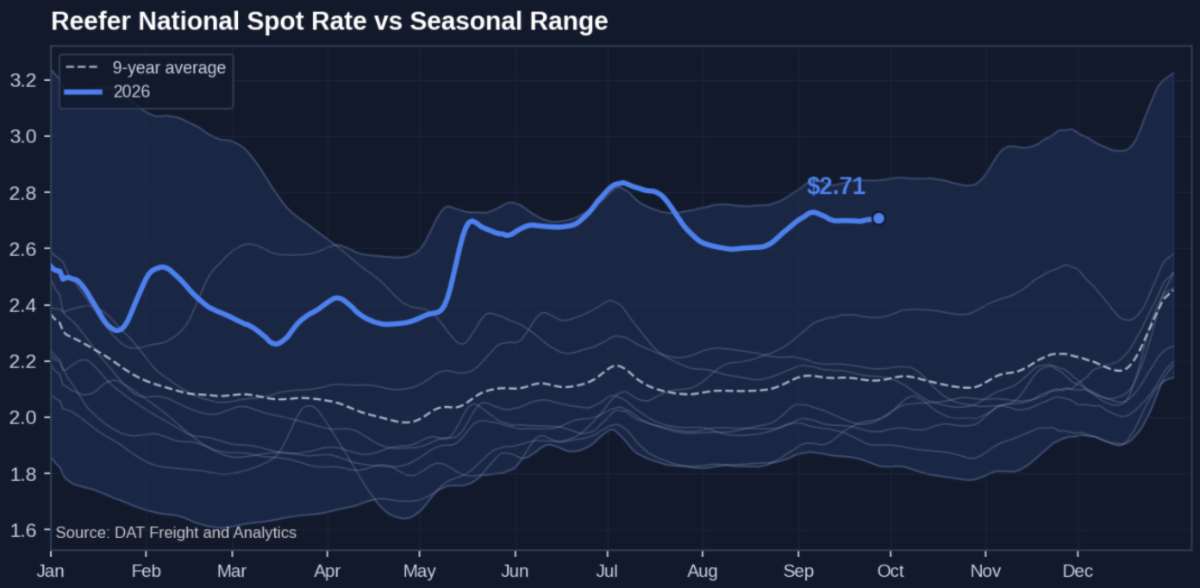
 Reefer Rates Dip but Remain Well Above Last Year
Reefer rates eased slightly last week as the early produce rush cooled, but the market remains firmly above both last year and historical norms.
- National average: $2.71/mile
- Vs. nine-year average: +27.1%
Produce cools, but capacity stays tight
Reefer load posts dropped 8.1% from the previous week, while equipment posts fell 8.4%, leaving both sides of the market moving almost in lockstep.
The load-to-truck ratio barely changed, ticking up from 18.20 to 18.26. Even as the initial produce surge pauses, available reefer capacity remains limited compared with last year.
Pacific Northwest pushes higher
Among the largest reefer origin regions, the Pacific Northwest posted the strongest weekly gain, jumping 4.2% to $3.17 per mile, followed by the Upper Midwest at $3.60 per mile, up 2%.
California moved the other direction, falling 3.3% to $2.95, although every major region remained at least 22% above year-ago levels.
Fall produce keeps premiums elevated
Washington apples and pears remain some of the highest-paying produce freight in the country, with seven of DAT’s 10 Yakima lanes above $10,000 per load and the Miami lane reaching as high as $14,800. California citrus also held onto the sharp increases from the prior week, while vegetable lanes into Chicago and Miami moved higher.
Meanwhile, South Texas cooled after its recent run-up, and late-season watermelon freight out of the Mid-Atlantic continued climbing.
Looking ahead
DAT’s 35-day forecast has reefer spot rates easing slightly to around $2.69 per mile by late October. That would still leave rates roughly $0.63 per mile above the same point last year, suggesting the seasonal surge may be cooling without doing much to erase the broader rate premium.
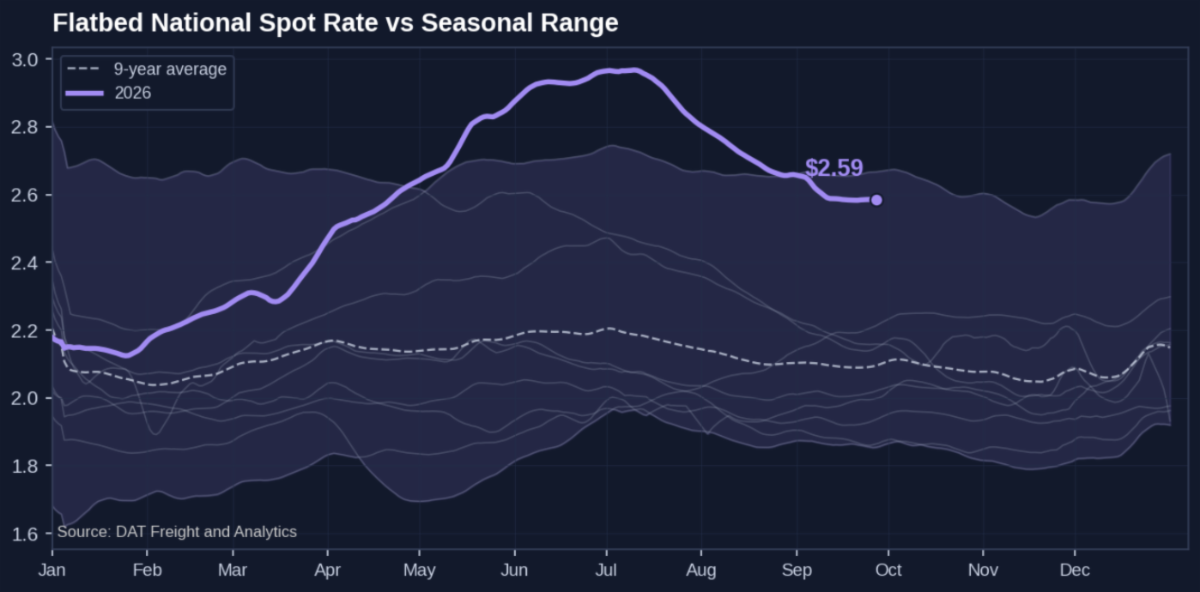
 Flatbed Demand Faces New Agricultural Headwinds
Flatbed rates edged lower again last week, but the market remains historically strong as available capacity continues to shrink.
- National average: $2.59/mile
- Vs. nine-year average: +23.4%
Capacity keeps doing the heavy lifting
Flatbed load posts slipped 0.8% week over week but remained 19.2% above last year. Equipment posts fell a much sharper 5.7% and were 21.4% below year-ago levels, pushing the load-to-truck ratio from 39.34 to 41.38, the tightest reading of any equipment segment last week.
Carolinas lead a mixed regional market
Across DAT’s bellwether states, outbound flatbed rates averaged $3.20 per mile, down just $0.01 from the prior week but still 26.4% higher year over year.
The Carolinas posted the strongest weekly gain among the top origin regions, rising 1.8% to $2.95 per mile, while the Ohio River and Southeast remained the highest-priced regions at $3.22 and $3.21, respectively. Every top-10 origin market continued to run above year-ago levels.
Farm equipment remains a demand concern
Agricultural equipment continues to loom as a potential headwind for open-deck freight, with excess farm machinery and softer equipment activity threatening to reduce one of flatbed’s traditional sources of demand.
For now, however, shrinking truck supply is helping offset those softer freight fundamentals and keeping rates near the upper end of their historical range.
Looking ahead
DAT’s 35-day forecast has flatbed spot rates easing slightly to around $2.56 per mile by late October. Even at that level, rates would remain roughly $0.53 per mile higher than the same point last year, suggesting the market can soften modestly without giving up much of its year-over-year premium.
Keeping Up With KCH:
Truck Parking Sucks - Let's Fix That.
KCH is teaming up with Truck Parking Club to help drivers find safe, legal parking, without the scavenger hunt.
Use code KCH25 at checkout for $25 off your next reservation.
Less time circling the lot. More time doing literally anything else.
Book Our Loads on Highway's TFX
We’re now posting freight on the Trusted Freight Exchange (TFX), a secure, Highway-powered network made for verified carriers like you.
It’s built right into Highway, free to use, and designed to connect you with quality freight fast.
Every KCH load on TFX is:
- Verified: posted by trusted shippers and brokers.
- Ready to roll: book it instantly and get moving.
With TFX, you skip the back-and-forth and get straight to hauling.
Get your SYLTD t-shirt
Support Your Local Truck Driver T-Shirt
$39.95
Connect with us on our social pages!