
Good morning, and welcome to The Cargo Club!
There’s a brief window every summer when the roads start to feel suspiciously pleasant.
Your commute gets shorter. The school buses disappear. You stop getting trapped behind a line of SUVs stretching three zip codes deep because someone’s child forgot their lunchbox.
And then August arrives.
School is back, which means so is the annual morning ritual of thousands of parents attempting to merge into traffic at exactly the same time with the urgency of a Secret Service motorcade.
Of course, I’m sure parents aren’t exactly thrilled. Getting a child dressed, fed, packed, and delivered to school before 8 a.m. seems less like a morning routine and more like running a small logistics operation with an extremely unreliable carrier.
If you don’t have kids, none of this concerns you personally. You’re simply an innocent bystander trapped in the blast radius.
– Greyson Harris

A coalition of states is suing the Trump administration to stop federal agencies from obtaining sensitive information on roughly 17 million commercial drivers nationwide.
Twenty-two state attorneys general and Pennsylvania filed two lawsuits Thursday challenging efforts by the Department of Transportation, Federal Motor Carrier Safety Administration, and Department of Homeland Security to access the Commercial Driver’s License Information System, or CDLIS.
According to the lawsuits, FMCSA demanded that the American Association of Motor Vehicle Administrators, which operates CDLIS on behalf of the states, provide records for every commercial driver in the system covering the past five years.
Those records include names, dates of birth, Social Security numbers, license information, driving histories, and other personally identifiable information.
And apparently “pretty please” was not the preferred negotiating strategy.
The states allege FMCSA threatened to terminate more than $10 million in federal funding and contracts if AAMVA refused to hand over the information. DHS later issued a subpoena seeking the same records.
So what’s the problem?
At the center of the dispute is a fairly fundamental question: who gets access to a database containing the personal information of nearly every commercial driver in America, and what exactly are they allowed to do with it?
The coalition argues that CDLIS belongs to the states and was created to allow licensing agencies to share information necessary to verify that drivers meet federal safety and qualification standards.
Massachusetts Attorney General Andrea Joy Campbell said the system allows states to check factors including medical fitness and driving history before issuing CDLs.
“The Trump Administration does not have the authority to use this state-owned database for unnecessary purposes and put the sensitive data of Massachusetts drivers at risk,” Campbell said.
The lawsuits accuse federal agencies of attempting to create a separate federal database using CDLIS records without properly notifying drivers or establishing safeguards governing how that information would be stored, shared, or protected.
The states also argue the administration failed to consult them before demanding the information and has not demonstrated a legitimate need for the entire database.
What is CDLIS?
Congress established CDLIS in 1986 as a state-to-state information-sharing network, and AAMVA has operated it under contract with DOT since 1988.
When someone applies for or renews a commercial driver’s license, states use the system to verify identity, driving history, medical qualifications, immigration status, and whether that person already holds a CDL somewhere else.
The states argue that CDLIS was never intended to become a centralized federal repository of commercial driver information. According to the complaints, federal officials have never previously sought access to the entire database.
New York officials warned that disruption to the system could affect nearly 500,000 CDL holders and roughly 20,000 commercial learner’s permit holders in that state alone, potentially complicating licensing and driver qualification checks.
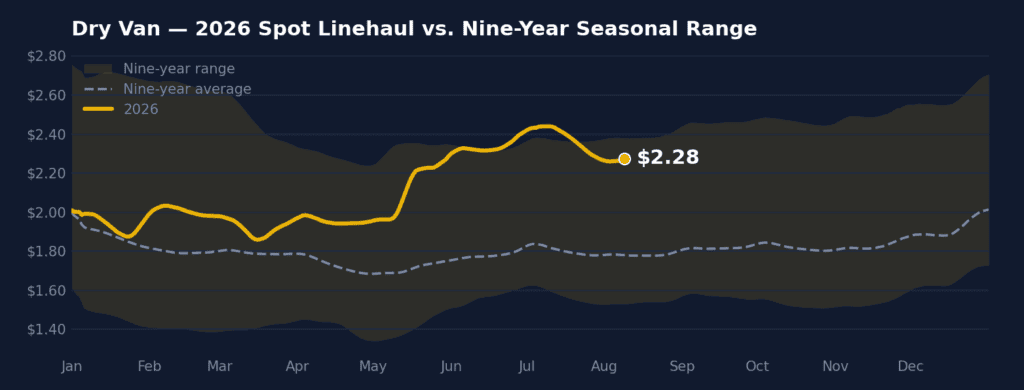
Dry van spot rates continued to ease this week as late-summer freight volumes softened, though pricing remains well above both last year and historical seasonal norms.
National dry van linehaul averaged $2.28 per mile, down four cents, or 1.8%, from the prior week. Despite the weekly decline, rates remained near the top of the historical range:
The 10 bellwether states averaged $3.01 per mile outbound, down six cents, or 2.1%, from the previous week but still nearly $1 higher than last year.
Those states accounted for 35.6% of all outbound dry van loads, remaining in line with the recent baseline near 35%.
The top 10 origin markets handled 87.8% of all U.S. outbound loads during the week. The Upper Atlantic was the lone standout, gaining 0.5% week over week, while most other major origins softened as summer freight volumes continued to fade.
Load postings fell 6.6% week over week while truck postings declined by a smaller 3.7%. That pushed the load-to-truck ratio down to 10.38, compared with 10.71 the previous week. Even with the decline, the ratio remains nearly double the 5.45 recorded during the same period last year.
Year over year, the underlying capacity picture remains considerably tighter:
DAT’s 35-day forecast projects dry van spot linehaul at approximately $2.23 per mile by mid-September, roughly five cents below the current market.
The forecast carries an uncertainty range of about eight cents in either direction, the widest band among the major equipment types.
Even at the projected $2.23 level, rates would remain approximately $0.59 per mile above the $1.64 recorded around the same point last year.
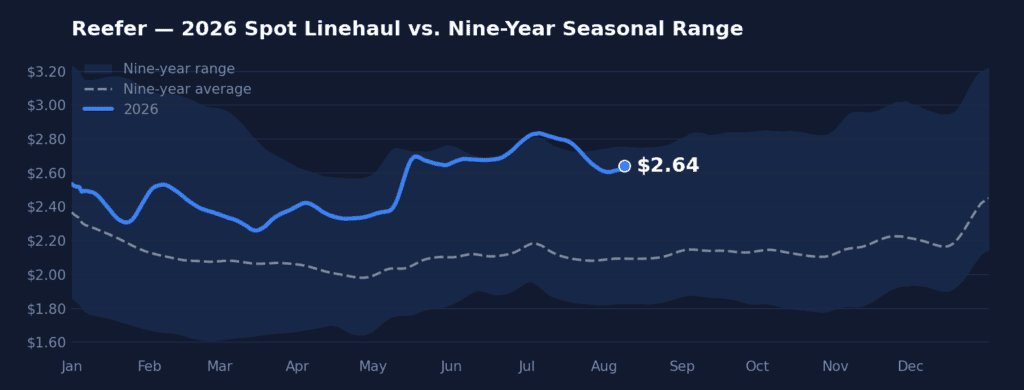
Reefer spot rates were nearly flat this week as summer freight volumes softened, but the market remains significantly tighter than it was a year ago.
National reefer linehaul averaged $2.64 per mile, down just one cent, or 0.3%, from the prior week. Rates remain near the top of the historical range:
The 10 bellwether states averaged $3.60 per mile outbound, down two cents, or 0.6%, from the previous week but still more than $1 higher than last year.
Those states accounted for 41.2% of all outbound reefer loads, slightly above the group’s typical 38% to 40% share.
The top 10 origin markets handled 84.3% of all U.S. outbound reefer loads during the week. The Upper Atlantic led the group with a 2.2% weekly increase, while most other major origins softened as summer volumes continued to ease.
Load postings fell 6.2% week over week, but truck postings declined even faster at 9.4%. With available capacity pulling back more quickly than freight demand, the load-to-truck ratio climbed to 19.51, up from 18.86 the previous week.
The year-over-year comparison remains especially tight:
DAT’s 35-day forecast projects reefer spot linehaul at approximately $2.61 per mile by mid-September, just three cents below the current market.
The forecast carries an uncertainty range of roughly six cents in either direction, the narrowest among the major equipment types.
Even at the projected $2.61 level, reefer rates would remain about $0.57 per mile above the $2.04 recorded around the same point last year.

KCH is teaming up with Truck Parking Club to help drivers find safe, legal parking, without the scavenger hunt.
Use code KCH25 at checkout for $25 off your next reservation.
Less time circling the lot. More time doing literally anything else.

We’re now posting freight on the Trusted Freight Exchange (TFX), a secure, Highway-powered network made for verified carriers like you.
It’s built right into Highway, free to use, and designed to connect you with quality freight fast.
Every KCH load on TFX is:
With TFX, you skip the back-and-forth and get straight to hauling.

Designed for shippers who want straightforward market insight and smarter freight strategies.