Good morning, and welcome to The Ship Show!
Tomorrow is the first day of October, which means we can finally begin pretending fall has arrived, regardless of what the thermometer says.
With autumn nearly in full swing, here are few things to expect in the coming month:
So settle in, keep a jacket nearby that you probably won’t need, and enjoy it.
The holidays are menacingly waiting just offstage.
– Greyson Harris
In this week’s issue:

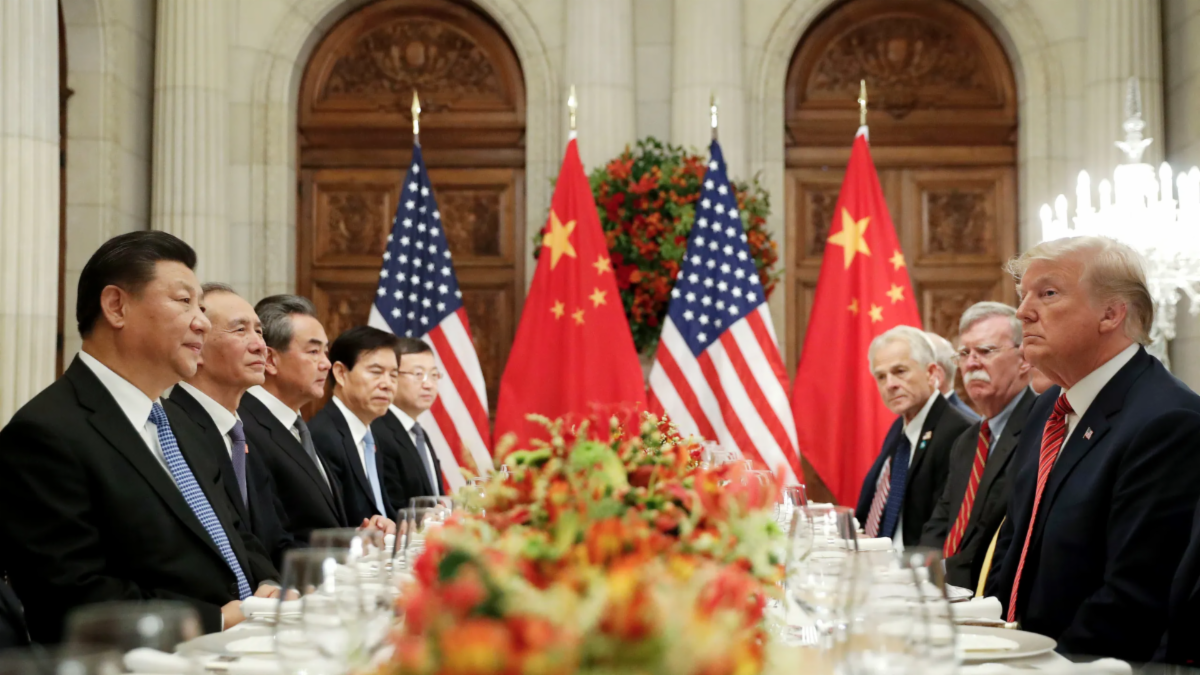
If the U.S.-Canada trade relationship had a Facebook status, we have officially moved beyond “It’s complicated.”
At 12:01 a.m. Tuesday, the U.S. followed through on its threat to ban nearly $1 billion worth of Canadian imports, including alcoholic beverages, certain dairy products, and motorcycles.
Meanwhile, the U.S. and China are preparing to move in the opposite direction, announcing plans to reduce tariffs on roughly $30 billion worth of goods from each country.
Eye for an eye
The latest escalation traces back to this summer, when President Trump used a rarely invoked provision of the Tariff Act of 1930 to impose 50% tariffs on roughly $20 billion worth of Canadian goods.
Canada responded with tariffs of 15%, 25%, and 50% on an equivalent amount of U.S. imports.
The White House then responded to Canada responding to the White House by announcing outright bans on several categories of Canadian goods.
At this point, the back-and-forth is resembling the couple that can’t seem to figure it out and makes it awkward for the whole friend group.
The restrictions cover about $967 million worth of Canadian imports based on 2025 trade data, with alcoholic beverages accounting for roughly 87% of that total.
Big headline, smaller impact
Despite the escalation, the direct economic damage is expected to be fairly limited.
Many of the affected products were already subject to 50% tariffs, meaning some had effectively priced themselves out of the U.S. market before the ban became official.
For freight markets, that means the immediate loss of cross-border volume may be limited. The larger concern is another layer of uncertainty being added to one of the most important trade relationships in North America.
Meanwhile, across the Pacific…
As restrictions tighten along the northern border, the U.S. and China announced plans Monday to lower tariffs on roughly $30 billion worth of goods moving between the two countries.
The U.S. list is made up largely of toys, sporting equipment, and Christmas decorations, potentially offering retailers some relief heading into the holiday season. China’s much longer list focuses heavily on American agricultural goods, along with products including hair care and packaged pet food.
There are still some fairly important details missing, namely when the tariff reductions will begin and exactly how much rates will fall.
That matters because tariffs are still a huge headache. Effective duties imposed by the two countries climbed above 40% on Chinese goods entering the U.S. and above 30% on American goods entering China last year.
Even modest reductions could encourage more trade. U.S. retailers could benefit from cheaper consumer imports before the holidays, while American exporters would gain some additional price competitiveness in the Chinese market.
The two governments also agreed to establish a new U.S.-China “Board of Trade,” with officials expected to meet at least quarterly and senior leaders meeting whenever necessary.
Which, given the last several years, may prove to be fairly often.
But wait, there’s more
The contrast in moves is pretty hard to ignore.
The U.S. is easing some barriers with China while simultaneously raising them against Canada, just as the U.S., Canada, and Mexico approach a critical period for the future of the USMCA, the agreement governing much of North American trade.
Canadian Prime Minister Mark Carney has responded by pushing Canada to reduce its reliance on the U.S., which accounts for more than 70% of Canadian exports. His government is pursuing deeper trade relationships with Europe, India, China, and other markets, with a goal of doubling non-U.S. trade over the next decade.
Trump, meanwhile, has argued that Canada will eventually return to the negotiating table and accept a deal. Carney says Canada remains willing to negotiate but has not ruled out additional retaliation.
Trade experts don’t expect a quick resolution, which means I’ll probably be talking about this crap again next week.

Americans have reviewed the economy and would like to speak to a manager.
Consumer confidence fell sharply in September, dropping to its lowest level in more than a decade as persistent inflation, expensive fuel, slower wage growth, and growing concerns about the labor market continued to wear on household finances.
The Conference Board’s Consumer Confidence Index fell 6.7 points to 81.9, down from 88.6 in August. That’s the lowest reading since April 2014, putting confidence below even its pandemic-era low.
Not exactly the kind of record anyone was chasing.
Widespread panic
The deterioration showed up almost everywhere in the survey.
The Present Situation Index, which measures consumers’ views of current business and labor conditions, dropped 7.9 points to 109.3.
The Expectations Index, which tracks the outlook for income, business, and employment over the next six months, fell another 5.9 points to 63.6, marking its third consecutive monthly decline.
For the first time since the Conference Board began asking the question four years ago, more respondents described their personal finances as bad than good.
These prices are too damn high
Consumers increasingly pointed to the cost of goods and services, particularly gasoline, as reasons for their worsening outlook.
Inflation expectations also rose, with respondents anticipating prices will increase 6.1% over the next year, up from 5.8% in August.
Regular gasoline is currently averaging around $4.46 per gallon, while prices for appliances, auto repairs, wireless services, and other everyday expenses have also climbed.
Turns out people tend to notice when nearly everything costs more at the same time.
Wages aren’t keeping up
Inflation isn’t the only pressure point.
Average hourly earnings increased 3.1% year over year in August, the weakest annual wage growth since May 2021. Consumer prices, meanwhile, were up 3.4% from a year earlier and jumped 0.4% in August alone.
That combination leaves households with less breathing room even when their paychecks are technically getting bigger.
The Federal Reserve responded to stubborn inflation earlier this month by raising its benchmark interest rate by a quarter point to a target range of 3.75% to 4%, its first rate increase since 2023.
That could eventually mean higher borrowing costs for mortgages, auto loans, credit cards, and other debt, providing another item for the family budget’s rapidly expanding collection of concerns.
Help (not) wanted
Jobs remain available, but consumers are becoming less confident about the labor market.
The gap between people saying jobs are “plentiful” and those saying they’re “hard to get” narrowed to just 1.7%, down 2.5 percentage points from August.
Job openings also declined by 256,000 in August to 7.08 million, with notable weakness in professional services and healthcare.
Still, the labor market has not fallen apart. Employers added 162,000 jobs in August, unemployment held at 4.1%, hiring edged higher, and layoffs slipped slightly.
Lacking confidence
The Conference Board isn’t the only survey showing a more pessimistic public.
The University of Michigan’s consumer sentiment index fell 7% in September to its second-lowest reading on record.
Confidence has a habit of spilling into actual spending. If households feel less secure about prices, jobs, and future income, they become more cautious about buying cars, furniture, electronics, vacations, and other discretionary goods.
For freight markets, that can eventually show up in softer retail orders, weaker imports, and less demand moving through warehouses and transportation networks.
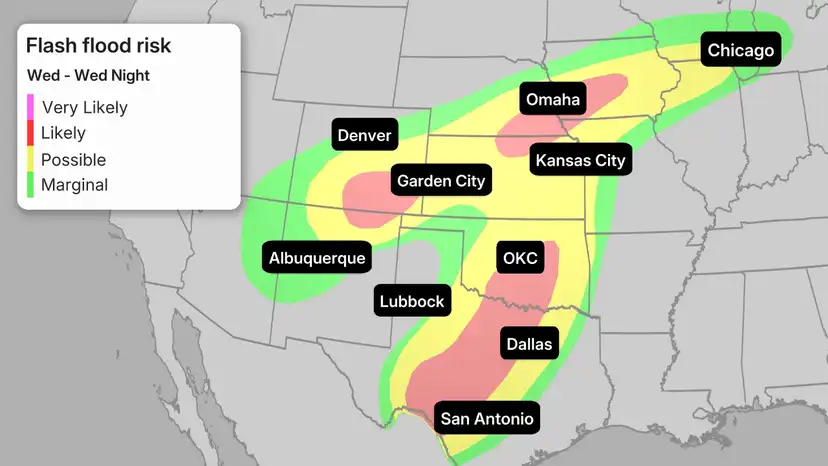
🌧️ Flood threat shifts from the Southwest into the Plains: After days of flash flooding across Arizona, New Mexico, and surrounding states, tropical moisture from former Hurricane Polo is pushing the heaviest threat east into Texas and the central Plains. Nearly 100 flood-related storm reports have been recorded since Monday, while flood watches now stretch from the Southwest through Texas and into parts of the Midwest. Central Texas could receive locally up to 8 inches of rain, with Dallas, Fort Worth, Austin, and surrounding areas facing an elevated flooding risk through Thursday.
🚂 U.S. rail traffic keeps rolling higher: U.S. railroads moved 535,663 carloads and intermodal units in the week ending Sept. 19, up 4.9% year over year. Carloads rose 2.4% to 234,207, while intermodal volume climbed 6.9% to 301,456 containers and trailers. Metallic ores and metals led commodity gains at 15.1%, while grain fell 7.7%. Through the first 37 weeks of 2026, combined U.S. rail traffic is up 3.4% from last year.
🚢 Trans-Pacific rates stay elevated while Mediterranean prices retreat: The Freightos Baltic Daily Index for China to the U.S. West Coast reached $8,446 per FEU on Sept. 23, nearly double its 12-month average of $4,381 and roughly four times September 2025 levels. Meanwhile, China-to-Mediterranean rates have fallen to $3,591 per FEU, down more than 50% from their July peak of $7,540.
✈️ Air cargo demand continues to climb: Global air cargo demand rose 4.4% year over year in August, with every region reporting growth. Capacity edged down 0.1% from August 2025. The gains came as global trade increased 6% year over year in July, extending its streak of annual growth to 33 consecutive months.
⛽️ Diesel prices finally take a breather: The DOE/EIA’s benchmark retail diesel price fell 14.7 cents to $6.382 per gallon, marking its first weekly decline in four weeks. The drop snaps a three-week run in which diesel set a new all-time high each week.

A shark took a wrong turn in South Korea earlier this month and somehow ended up with a fan club, a government title, and more than 600,000 visitors.
The 11.5-foot bronze whaler shark, nicknamed Bukangi, has been swimming in a narrow canal at Busan’s North Port since Sept. 18.
What began as an unusual wildlife sighting quickly turned into one of the city’s biggest attractions, drawing crowds large enough that officials eventually had to warn people about traffic congestion around the waterfront park.
Overnight celebrity
Bukangi’s name combines “Buk Hang,” the Korean name for North Port, with a suffix commonly added to names in Korean.
The shark became a sensation almost immediately, but things really escalated during the four-day Chuseok holiday.
Roughly 483,000 people visited the park during that stretch alone, compared with its usual holiday traffic of around 2,000 visitors per day. At one point, more than 100,000 people showed up in a single day.
Public interest grew enough that Busan named Bukangi an honorary promotional ambassador after 91% of roughly 8,000 people participating in a city poll supported the idea.
Not bad for an animal whose entire marketing strategy has consisted of being lost. The problem is that Bukangi isn’t supposed to be there.
Officials say the shark has not been observed feeding since arriving in the artificial waterway, raising concerns that an extended stay could eventually weaken the animal even though inspections have shown its activity and breathing remain stable.
I ain’t f-ing leaving
Authorities attempted a rescue Tuesday involving the Busan Coast Guard, fisheries officials, five vessels, and streams of water designed to slowly guide Bukangi toward the open sea.
Bukangi declined to cooperate, likely because he’s a shark.
As boats moved through the canal spraying water, the shark repeatedly slipped behind them and swam back in the other direction. After more than five hours, officials called off the operation.
The city now plans to try again using a custom-made net designed specifically for the width and depth of the canal, with another rescue attempt expected later this week.
In fairness, successfully avoiding five boats, the Coast Guard, and several government agencies suggests Bukangi is doing reasonably well in at least one category of shark survival.
Please do not feed the shark
The strange episode has been good for local foot traffic, but officials and environmental groups have also cautioned against treating the shark entirely as an attraction.
Experts have raised questions about why sharks are appearing near the port more frequently and whether warming waters could be changing their movement patterns.
Meanwhile, the immediate priority remains getting Bukangi safely back into open water before its health begins to deteriorate.
Until then, Busan’s newest promotional ambassador will continue circling the canal, drawing crowds, and refusing to cooperate with his own rescue.


We’re now posting freight on the Trusted Freight Exchange (TFX), a secure, Highway-powered network made for verified carriers like you.
It’s built right into Highway, free to use, and designed to connect you with quality freight fast.
Every KCH load on TFX is:
With TFX, you skip the back-and-forth and get straight to hauling.

The U.S. has 23 million truck parking spots. You should be able to find one without feeling like you’re on a wild goose chase.
We’re teaming up with Truck Parking Club to make that happen.
Use code KCH25 for $25 off your next reservation.
Less wandering. More rest.
Designed for shippers who want straightforward market insight and smarter freight strategies.