
Good morning, and welcome to The Ship Show!
Yesterday, we lost what might have been the closest thing America ever had to a universally beloved celebrity.
Dolly Parton died yesterday at 80 after a brief battle with cancer, ending a life that somehow stretched from a one-room cabin in the mountains of East Tennessee to country music royalty, Hollywood, theme parks, philanthropy, and just about every corner of American culture.
Part of Dolly’s magic was that she spent nearly seven decades being famous without ever becoming exhausting.
That alone feels statistically impossible.
She was instantly recognizable, endlessly quotable, and wore enough rhinestones to interfere with local radar, but somehow never lost the sense that she was still just Dolly. Funny, warm, self-aware and completely comfortable being in on the joke.
And underneath all of that sparkle was a staggering amount of substance:
When people needed help, she had a habit of actually showing up.
For me, there was also a little hometown connection that made her feel even closer. I grew up in Ringgold, Georgia, the tiny town where Dolly and Carl Dean slipped away to get married in 1966.
That little piece of history became part of Ringgold’s identity, the kind of hometown fact you learn almost by osmosis. You could grow up there without knowing much about country music and still know, with absolute certainty, that Dolly Parton got married in Ringgold.
There was something wonderfully unusual about the way Dolly occupied the world. She could be larger than life and completely down to earth at the same time.
She looked like a fabulous firework had exploded inside a beauty salon. She laughed at herself before anybody else got the chance, and never seemed particularly interested in convincing people she was important.
Maybe that’s why losing her feels different from the usual celebrity obituary.
Dolly represented something reassuring: proof that enormous success didn’t have to make you cynical, that you could be ambitious without becoming cruel, and that getting more than you ever dreamed of didn’t mean you had to stop looking around for somebody to share it with.
But becoming one of the exceedingly few people who could walk into almost any room in America and inspire some version of, “I love Dolly,” might have been the most impressive accomplishment of all.
She spent 80 years giving us plenty of reasons to say it.
– Greyson Harris
In this week’s issue:

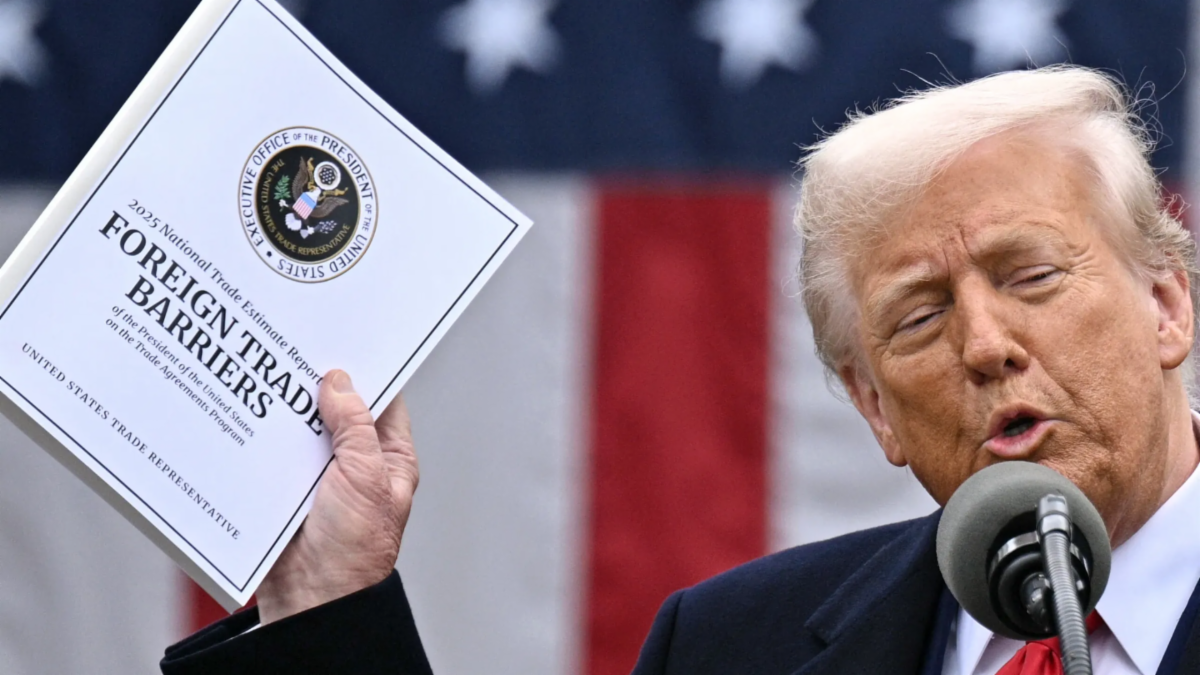
If you’ve checked the news at any point this week and thought, “Surely that can’t also affect the supply chain,” congratulations. It probably does.
The federal government has spent the past few days pulling nearly every lever available to it:
The global supply chain has several browser tabs open, they’re all playing audio, and nobody can figure out which one it is. So, rather than pretend these are separate stories, here is the current state of everything.
Is it too late now to say sorry?
Trade negotiations between the United States and Canada collapsed Friday, triggering new 50% U.S. tariffs on roughly $20 billion worth of Canadian imports beginning Saturday.
The tariffs cover more than 550 products, including goods from the forestry, dairy, textile and manufacturing sectors. Fun fact: fake mustaches were specifically listed in the report, so not even novelty facial hair is safe from tariffs.
In June alone, U.S.-Canada cross-border freight totaled roughly $67.9 billion, with trucks moving a massive share of that trade.
Automobiles, machinery, energy products, steel, aluminum, agriculture and countless intermediate goods routinely cross the border, sometimes multiple times before becoming finished products.
How is this being received by both nations? About as well as you’d imagine:
This relationship is going great!
Meanwhile, in the Middle East…
While Washington argues with its northern neighbor, the Trump administration has opened another front thousands of miles away.
The Treasury Department announced Operation Economic Outcast, a campaign designed to further isolate Iran from global commerce, and also a great name for a band. I will always enjoy this bit.
The Treasury Department’s new campaign is designed to further isolate Iran from the global economy by targeting the countries, companies and vessels helping it trade.
Nearly 60 entities, individuals and vessels were immediately sanctioned over alleged involvement in Iranian oil exports, military procurement, cyber operations and its shadow shipping fleet.
Treasury Secretary Scott Bessent called those measures only a “warning shot,” which is… comforting?
The larger threat is secondary sanctions against foreign companies and countries that continue facilitating Iranian trade in oil, shipping, aviation, gold, technology and cryptocurrency.
Which brings us, naturally, to China.
Other than the extremely ham-handed codename, there’s another slight complication with Operation Economic Outcast.
Before the current conflict, China purchased roughly 80% of Iran’s exported oil. The administration says nobody will be exempt from its sanctions push, which creates the possibility that Washington could eventually have to target Chinese businesses for continuing to buy Iranian crude.
That would be happening while the U.S. is simultaneously trying to manage its already complicated trade relationship with Beijing, ahead of Chinese President Xi Jinping’s expected visit to the U.S. next month.
Whether enforcement matches that rhetoric remains one of the biggest questions hanging over the sanctions campaign.

Before there was a trade war over steel, semiconductors or electric vehicles, there was chicken.
In the early 1960s, American poultry producers got extremely good at raising cheap chickens and began shipping them to Europe in huge quantities. European farmers were not thrilled about being undercut by a tidal wave of affordable U.S. drumsticks, so France and West Germany slapped tariffs on American poultry.
The United States responded in 1964 with tariffs of its own on potato starch, brandy, and, for reasons that would become much more important than anyone probably expected, light trucks.
Thus was born the Chicken Tax.
The Chicken War begins.
America got extremely good at producing chicken after World War II.
Industrial farming, improved breeding, cheaper feed and increasingly efficient processing allowed U.S. poultry companies to produce enormous quantities of inexpensive chicken. American producers began shipping that cheap poultry overseas, and Europeans started eating it.
This was fantastic news if you were an American chicken farmer. It was considerably less fantastic if you were a European chicken farmer.
As the European Economic Community, the precursor to today’s European Union, developed a common agricultural policy in the early 1960s, it introduced tariffs and import levies designed to protect European farmers from cheaper foreign competition.
Duties on U.S. broiler chickens entering West Germany increased from roughly 5 cents per pound to around 13 cents. Congressional testimony at the time described those charges as equivalent to roughly 43% of the value of the imported chicken. The U.S. government estimated American poultry producers were losing around $46 million per year.
Eventually, Washington decided Europe needed to experience the joy of retaliatory trade policy for itself.
Tariffs have always been silly.
On Dec. 4, 1963, less than two weeks after Lyndon B. Johnson became president following John F. Kennedy’s assassination, Johnson signed Proclamation 3564.
The proclamation specifically accused the European Economic Community of maintaining unreasonable restrictions on American poultry and announced retaliatory U.S. tariffs beginning Jan. 7, 1964.
The targets were:
That last category received a 25% tariff. Before the retaliation, imported trucks had generally faced an 8.5% duty. Why trucks?
The administration needed European products worth enough money to roughly compensate for the poultry trade America believed it had lost. Volkswagen was also becoming increasingly successful in the United States, including with its commercial vans and pickups.
So the humble imported truck was drafted into the Chicken War. The potato starch presumably never saw it coming either.
The Chicken War ended, but the tax didn’t.
Most of the retaliation eventually disappeared. The truck tariff did not.
More than half a century later, the 25% truck duty is the only original Chicken War tariff remaining in place. That’s an incredible lifespan for a policy created because Europe didn’t want our frozen chicken.
But foreign automakers weren’t ready to simply surrender the U.S. truck market. They started getting creative. Very creative.
A little too creative, perhaps.
By the 1970s, Japanese mini-pickups were becoming increasingly popular in America. Toyota and Nissan wanted to sell trucks here, as did American manufacturers that were importing small Japanese-built pickups under their own brands.
There was just one problem: chicken. So, how do we get around this little issue?
A fully assembled imported light truck faced the 25% duty, but a truck cab and chassis without the cargo bed attached could receive a much lower tariff. You can probably see where this is going.
Automakers began shipping nearly finished trucks to the United States without their beds. The cargo boxes traveled separately. Once everything arrived in America, workers attached the beds and, voilà, it was suddenly a pickup truck.
Technically, the finished pickup had never been imported. Just most of one. For about a decade, U.S. Customs allowed it.
In 1979 alone, roughly 389,000 Japanese mini-pickups valued at $1.4 billion entered the United States using the cab-chassis arrangement. About half were sold by Toyota and Nissan, while the rest were imported for GM, Ford and Chrysler. Officials found that completing the trucks in America involved less than 3% of their parts and 7% of their final value.
Home Field advantage.
Of course, manufacturers eventually discovered a substantially easier workaround. Don’t import the truck. Build it in America.
The Chicken Tax has long provided a major incentive for foreign automakers interested in America’s enormous pickup market to manufacture vehicles domestically or elsewhere in North America under favorable trade rules rather than simply shipping finished pickups from overseas.
Toyota was one of the first to dip their toes into the American waters, producing the Tundra domestically. Other foreign manufacturers followed similar paths, investing billions in North American assembly plants and supplier networks.
Today, the nationality of the badge on a pickup’s grille tells you surprisingly little about where it was actually built:
The Chicken Tax certainly isn’t solely responsible for that manufacturing landscape, but for decades it has been one unusually large thumb sitting on the scale.
Chicken rules everything around me.
Tariffs are usually discussed as percentages on spreadsheets. Their actual effects are much stranger.
As a result of the Chicken Tax:
And unlike the trade dispute that created it, the policy proved remarkably durable.
The original Chicken War was a relatively short-lived argument over European agricultural protection and American poultry exports. But the 25% truck tariff escaped containment.
More than six decades later, its salmonella-covered fingerprints remain all over the American automotive industry.
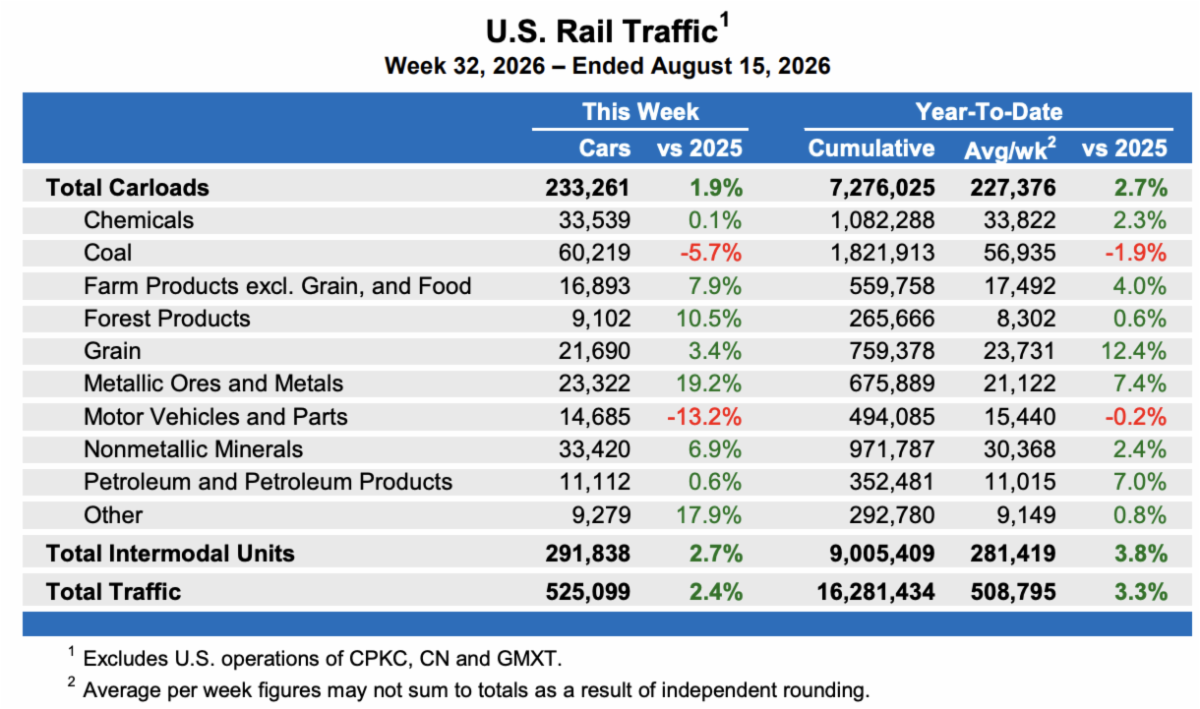
🚂 Steel boosts weekly rail traffic: U.S. rail traffic rose 2.4% year over year in the week ending Aug. 15, with carloads up 1.9% and intermodal volume up 2.7%, according to the Association of American Railroads. Metallic minerals and ores led the gains with a 19.2% increase as tariffs and tighter enforcement supported domestic steel production. Through the first 32 weeks of 2026, total U.S. rail traffic is up 3.3% from last year.
🚔 Houston postal workers charged in $24 million check theft scheme: Federal prosecutors have charged five people, including three U.S. Postal Service carriers, in an alleged scheme involving nearly $24 million in stolen checks. Authorities say the checks were taken from Houston mail routes, marketed to buyers through a Telegram channel and shipped nationwide using FedEx. The alleged conspiracy ran from October 2022 through September 2024 and included one check worth more than $1.5 million. FedEx has not been accused of any wrongdoing.
🚢 Panama Canal tightens capacity as drought concerns return: The Panama Canal Authority will reduce daily vessel transits from 36 to 34 on Sept. 4, then to 32 on Sept. 15, as below-average rainfall and a possible 2026–2027 El Niño raise concerns about water availability. The authority also delayed planned draft increases for Neopanamax vessels, which could limit how much cargo ships can carry through the canal. Because more than 70% of canal cargo is tied to the U.S., tighter capacity could disrupt East and Gulf Coast schedules, raise reservation competition, and push some Asia-U.S. freight toward West Coast ports and rail.
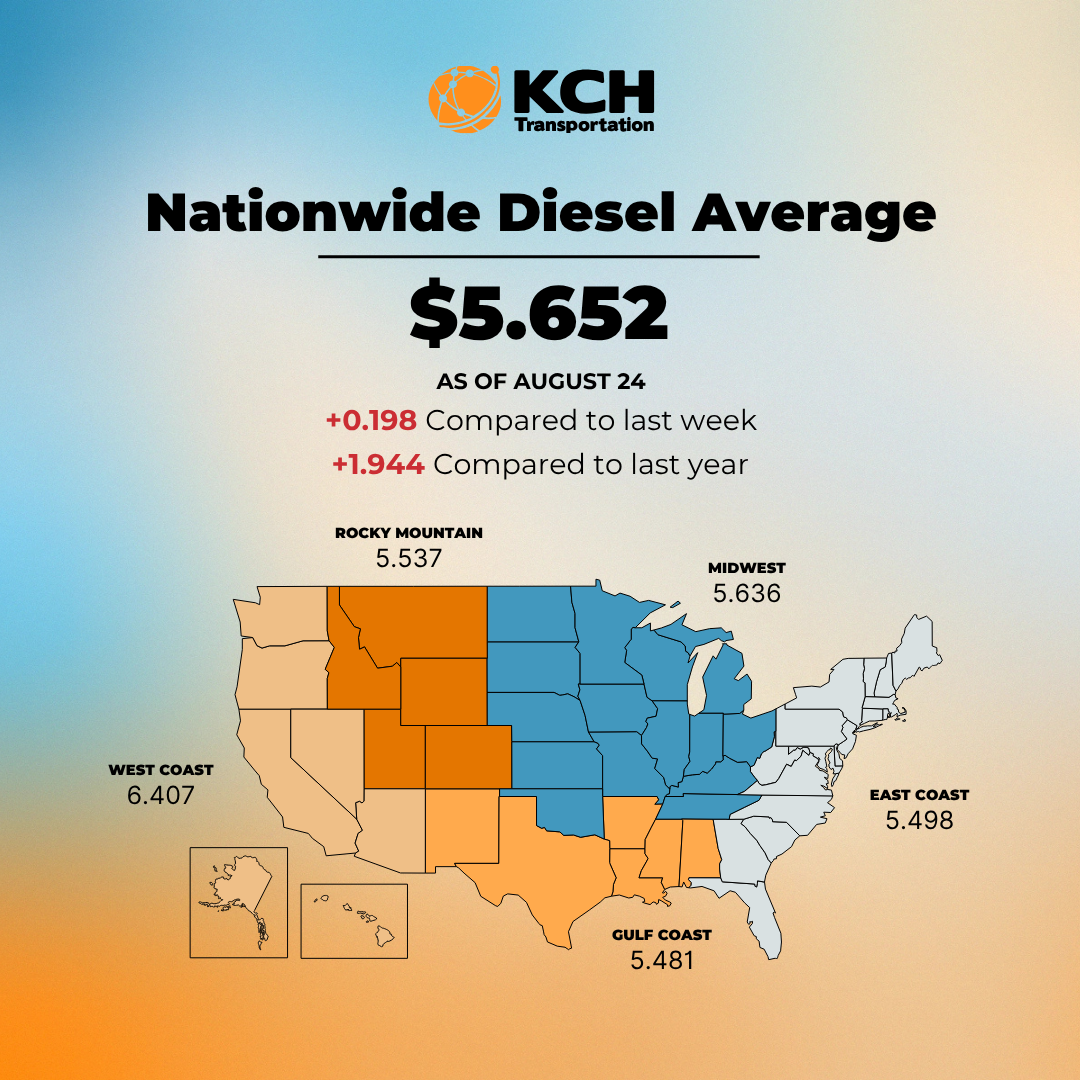
Diesel prices surged again this week, pushing the benchmark used for most fuel surcharges to its highest level since military action against Iran began in early March.
The Department of Energy/Energy Information Administration’s average retail diesel price jumped 19.8 cents to $5.652 per gallon, topping the previous post-conflict high of $5.643 set April 6.
Diesel has now risen 39.5 cents per gallon in just two weeks.

Usain Bolt is still the fastest human on Earth. You may noticed the emphasis on “human.”
A Chinese humanoid named Lightning recently ran the 100-meter dash in 9.32 seconds, beating Bolt’s legendary 9.58-second world record set in 2009.
For anyone keeping score at home, a machine can now outrun every human being who has ever lived.
Robot Olympics.
The second World Humanoid Robot Games brought more than 2,000 robots from hundreds of teams across 16 countries to Beijing for five days of competition.
And we’re using the word “competition” pretty broadly here.
The robots participated in more than 1,000 contests across 51 events, including running, soccer, table tennis, weightlifting and tug of war. There were also competitions designed around more practical applications, giving developers opportunities to test machines performing tasks closer to what they might eventually encounter in homes, factories and workplaces.
They seem to be adapting pretty quickly.
Lightning also competed in a Beijing humanoid half marathon earlier this year, completing the distance in just 50 minutes and 26 seconds, faster than the human world-record pace. Another robot completed a standing jump of 2.88 meters, higher than Javier Sotomayor’s longstanding human high-jump record of 2.45 meters.
Before anyone starts demanding that the IOC investigate mechanical doping, there is an important distinction here: these machines aren’t competing under comparable conditions to human athletes, obviously.
So Bolt can probably keep the medal, but that’s also sort of beside the point.
Extreme product testing.
China isn’t pouring money into humanoid robots because it desperately wants to dominate the 2032 Olympic 4×100 relay. The Games are essentially one enormous public stress test.
Humanoid robots have become an increasingly important part of China’s technology strategy, with companies and policymakers betting that improvements in artificial intelligence, sensors, batteries and mechanical hardware could eventually push the machines into manufacturing, logistics and consumer applications.
China already produces the majority of the world’s humanoid robots, and the Games arrived during the same week as Beijing’s World Robot Conference, where companies showcased thousands of robotics products.
That makes the sporting events considerably more useful than they might initially appear.
The real prize isn’t a gold medal. It’s building a machine that can eventually walk into a warehouse, factory or distribution center and do useful work.
Stopping is still a work-in-progress.
For all the unsettling progress displayed in Beijing, the Robot Games also provided a reassuring reminder that our new mechanical overlords are still figuring some things out.
Namely: momentum.
Several robots crossed the finish line after their 100-meter sprint at ridiculous speeds before discovering that slowing down is considerably more complicated.
Lightning’s record-setting sprint concludes with the robot barreling straight into a padded wall.
No hesitation. No attempt to negotiate. Just 32 mph of cutting-edge artificial intelligence meeting an immovable object.
If the image of robots crashing into a wall brings you joy, check out this footage from the event.
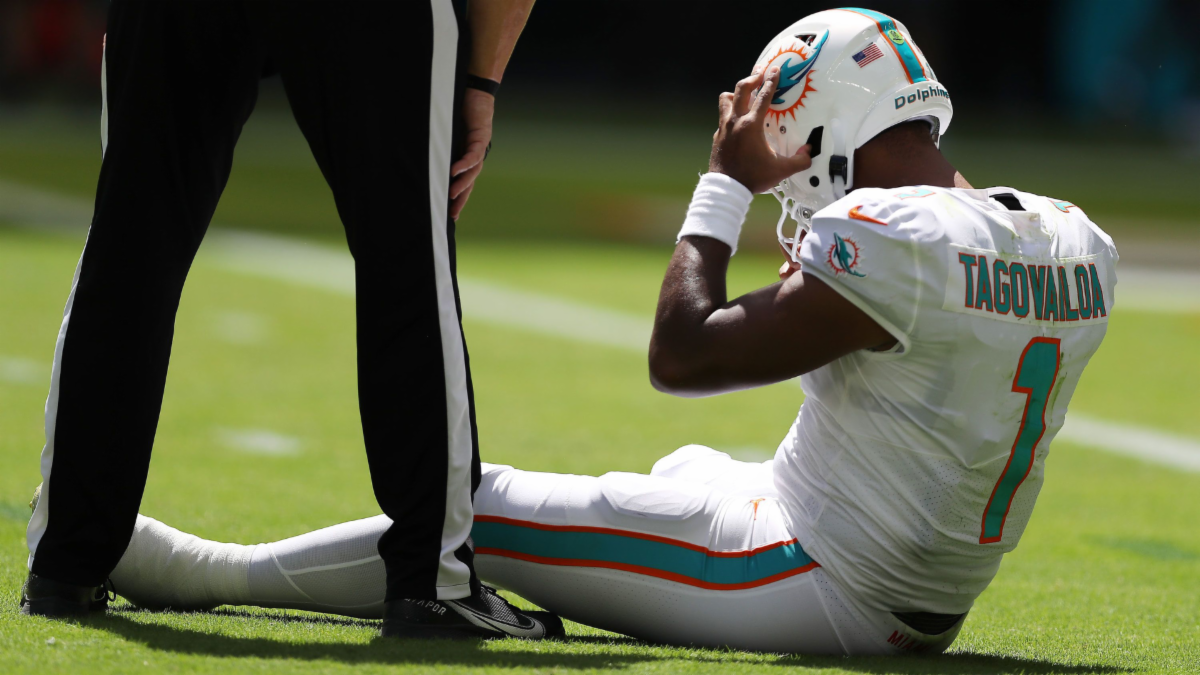
Football has spent the better part of two decades wrestling with an uncomfortable question: Just how common is CTE among the people who play the game at its highest level?
A new study has finally put something resembling a number on it.
Researchers found that at least 24.5% of former NFL players who died between 2016 and 2021 had chronic traumatic encephalopathy, the degenerative brain disease associated with long-term exposure to repeated head impacts. And researchers are emphasizing the words at least.
Of the 878 former players who appeared in at least one NFL game and died during the six-year period, 235 had their brains donated for research. CTE was found in 215 of them, or 91.4%.
But researchers know brain donations create a major selection problem. Families who suspect neurological problems are considerably more likely to donate a loved one’s brain, meaning it would be misleading to conclude that 91% of all NFL players develop CTE.
So they went in the opposite direction.
One in four is the floor.
To calculate the most conservative possible prevalence, researchers assumed that none of the other 643 players whose brains weren’t examined had CTE.
Even under that extraordinarily generous assumption, 215 confirmed cases among 878 deceased players produces a prevalence of 24.5%.
On the opposite extreme, if every unexamined player had the disease, prevalence could theoretically have reached 97.7%.
Neither extreme is considered likely. Lead author Dr. Daniel Daneshvar said the actual number sits somewhere in between, with researchers planning additional work to narrow that range.
However, previous brain-bank studies have produced much more frightening percentages. Boston University’s CTE Center announced in 2023 that it had found CTE in 345 of 376 former NFL players studied, nearly 92%. Researchers explicitly warned, however, that the sample should not be interpreted as representative of every NFL player because of that donation bias.
The new research attempts to move one step closer to answering that question, and even its absolute best-case scenario isn’t particularly comforting.
What exactly is CTE?
The CDC says CTE is associated with long-term exposure to repeated head impacts, including hits that don’t produce any obvious concussion symptoms.
In other words, the concern isn’t necessarily just the massive helmet-to-helmet collision that stops a game. It’s also the hundreds or thousands of smaller collisions accumulating over years.
A 2023 NIH-backed study found that the number and force of repeated head impacts were better predictors of CTE than a player’s reported concussion history. Every additional 1,000 estimated head impacts was associated with a 21% increase in the odds of having CTE in that study.
Earlier Boston University research found another disturbing relationship. The longer someone played tackle football, the greater the risk. Researchers studying 266 former players found that each additional year of football was associated with 30% higher odds of developing CTE, with the odds doubling roughly every 2.6 years of play.
The disease itself can progress through four pathological stages, and newer research has strengthened the connection between its most advanced forms and dementia.
An NIH-funded study published earlier this year found that people with Stage IV CTE were about 4.5 times more likely to have had dementia than those without the disease. Less severe Stage I and II CTE was not associated with dementia or measurable cognitive decline in that study.
This isn’t a new problem.
The modern NFL’s CTE story can largely be traced back to former Pittsburgh Steelers center Mike Webster.
After Webster died at 50 in 2002 following years of severe physical and cognitive problems, neuropathologist Dr. Bennet Omalu examined his brain and discovered a pattern of damage previously associated primarily with boxers.
Webster became the first NFL player diagnosed with CTE, and Omalu published his findings in 2005.
Over the years, CTE has subsequently been diagnosed after death in numerous prominent former players, including Junior Seau, Dave Duerson and Aaron Hernandez.
The league is changing, but is it enough?
Football today isn’t played exactly the way it was when Webster was lining up for the Steelers.
The NFL’s 2011 collective bargaining agreement substantially limited full-contact practices. The league has altered kickoff rules, strengthened concussion protocols, introduced position-specific helmets, and expanded use of Guardian Caps during practices.
Those efforts have produced measurable improvements in acute injuries. The NFL reported that concussions during the 2024 season fell 17% from the previous year to the lowest level recorded by the league, while Guardian Cap use has also been associated with significant reductions during mandated practice sessions.
That’s progress, but a concussion count and long-term exposure to repetitive head impacts aren’t necessarily the same problem.
That’s why the NFL Players Association called the new findings a “call to action across the entire football ecosystem,” pointing not only to professional football but to the years players spend absorbing hits before they reach the league.
Texans linebacker Azeez Al-Shaair perhaps put the dilemma most simply when asked recently about CTE: “The reality of the game is that it’s aggressive. It’s violent,” he said. “We’re out here running at each other.”
And that’s the problem football has never been able to completely engineer away.
You can build a better helmet. You can eliminate unnecessary practice collisions. You can change tackling techniques and remove particularly dangerous plays.
But eventually, two extraordinarily large, fast human beings still have to run into each other.



We’re now posting freight on the Trusted Freight Exchange (TFX), a secure, Highway-powered network made for verified carriers like you.
It’s built right into Highway, free to use, and designed to connect you with quality freight fast.
Every KCH load on TFX is:
With TFX, you skip the back-and-forth and get straight to hauling.

The U.S. has 23 million truck parking spots. You should be able to find one without feeling like you’re on a wild goose chase.
We’re teaming up with Truck Parking Club to make that happen.
Use code KCH25 for $25 off your next reservation.
Less wandering. More rest.

Designed for shippers who want straightforward market insight and smarter freight strategies.